
TL;DR

Get workout gear delivered free with Prime
- Fast, free delivery on millions of items
- Prime Video, Amazon Music and more included
- Member-only deals all year
Researchers at Nottingham Trent University and Integrated System Technologies Ltd developed and tested a home-monitoring prototype combining radar, thermal sensors and smart plugs. In a mock home, combining the sensors improved activity-recognition performance, but the study does not establish how accurately the system detects medical emergencies in everyday homes.
Nottingham Trent University researchers and Integrated System Technologies Ltd have developed and tested a prototype that combines radar, thermal sensors and smart plugs to monitor activity patterns at home, with the aim of identifying possible emergencies while avoiding cameras and wearable devices. The study, published in the journal Sensors, reports improved activity-recognition performance when the sensor data were combined in a mock domestic environment; it does not establish that the system is ready for clinical or routine use.
The system uses millimeter-wave radar to detect movement, thermal sensors to identify broad postures such as sitting, standing, walking and lying down, and smart plugs to register patterns in appliance use. The thermal output is kept at low resolution and pixelated, according to the researchers, to avoid showing faces or detailed images. The approach is designed to monitor routines without requiring a resident to wear a device or be observed by a camera.
Artificial intelligence combines information from the three sources and learns a resident’s behavior patterns over time. The researchers say unusual activity could prompt an alert to care professionals or family members, who could check on the person remotely or in person. Examples of potential warning signs include a fall, prolonged inactivity, a change in mobility, altered sleep patterns or household routines that differ from a person’s usual behavior. These are described as possible indicators, not confirmed diagnoses.
For the study, the team assessed the sensors in a mock domestic setting with six room layouts, including bedrooms and living areas with different furniture arrangements. Researchers recorded activities to evaluate whether the system could recognize movement and posture. They reported that combining sensor information improved performance compared with relying on individual technologies, but the supplied report does not give detailed accuracy figures or evidence from long-term monitoring in occupied homes.
Privacy and Independent Living
The research addresses a practical challenge for older adults who want to remain at home: how to notice potential changes in wellbeing without relying on cameras or wearable devices. The researchers say a system that works reliably could give caregivers an additional way to identify unusual patterns and check whether someone needs help, without requiring a resident to remember or tolerate a wearable device.
However, the potential benefit remains conditional. The reported results describe a prototype tested in a mock domestic environment, not a proven service that can reliably identify heart attacks, strokes or other medical emergencies in daily life. Sensor alerts could support a check-in, but should not be presented as a substitute for emergency services, medical assessment or human care. Practical questions also include how residents consent to monitoring, who receives alerts and how the system handles missed or unnecessary alerts.
As an affiliate, we earn on qualifying purchases.
How the Prototype Was Evaluated
The work is titled “Privacy-Preserving Ambient Sensing for Activities of Daily Living: Multimodal Radar-Thermal Human Activity Recognition and Smart Plug Appliance Recognition.” It was published in Sensors in 2026. The research involved Nottingham Trent University and Integrated System Technologies Ltd, with contributors from the university’s School of Architecture, Design and the Built Environment and School of Science and Technology.
The three sensor types capture different parts of daily activity: radar detects movement, thermal sensing estimates posture, and smart plugs record appliance-related behavior such as use associated with making a drink or preparing food. The researchers argue that putting these signals together can provide a fuller picture of routine than any one source alone. Their tests examined activity recognition across six simulated room arrangements; the report does not describe a trial involving older residents living independently over an extended period.
“This technology aims to support the growing number of older adults who wish to remain in their own homes for longer, rather than moving into residential care.”
— Dr. Yangang Xing, lead researcher at Nottingham Trent University
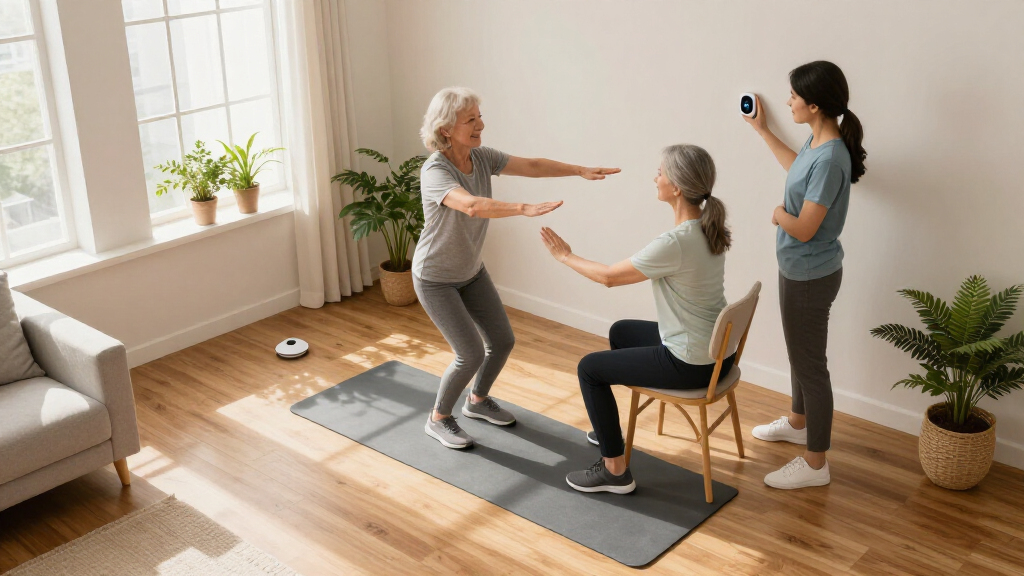
smart home emergency detection system
As an affiliate, we earn on qualifying purchases.
As an affiliate, we earn on qualifying purchases.
Limits of the Current Evidence
The reported evaluation took place in a mock domestic environment; the source does not provide results from a long-term trial in real homes occupied by older adults. It also does not specify the system’s detailed accuracy, how often it might generate false alarms, how frequently it could miss an event, or whether it can distinguish a medical emergency from other causes of unusual movement or inactivity.
It is not clear when the prototype might be tested in residents’ homes, whether it has regulatory approval, what it would cost to install and operate, or how it would connect to existing care services. The researchers’ description of detecting events such as heart attacks or strokes is an intended capability, not evidence that the system has been clinically validated to detect those conditions. Data storage, access controls and residents’ consent arrangements are also not detailed in the supplied report.
As an affiliate, we earn on qualifying purchases.
Further Testing in Real Homes
The next evidence needed would come from testing the system in real homes over time, with participants’ consent and appropriate privacy protections. Such work would need to report performance across different homes and routines, including how often alerts are accurate, missed or unnecessary, and how quickly caregivers can respond.
The source does not announce a date for those studies or a launch plan. Until further results are reported, the system remains a research prototype with a proposed role in ambient home monitoring, rather than a confirmed replacement for existing care or emergency-response arrangements.
As an affiliate, we earn on qualifying purchases.
Key Questions
What does the home sensor system use?
It combines millimeter-wave radar to detect movement, low-resolution thermal sensors to identify broad postures, and smart plugs to record appliance-use patterns. An AI system combines the data to learn and monitor activity routines.
Does the system detect heart attacks or strokes?
The researchers describe these as possible events the system is intended to flag. The reported study does not show that it can diagnose or reliably detect heart attacks, strokes or other medical conditions in real-world use.
Has it been tested in older people’s homes?
The reported testing used a mock domestic environment with six room layouts. The source does not report a long-term trial in occupied homes with older residents.
How does the design aim to protect privacy?
It does not rely on cameras or wearable devices. The researchers say thermal images are highly pixelated and low resolution, while radar and smart plugs provide movement and appliance-use information rather than conventional video. The report does not detail data storage or access arrangements.
When might the system become available?
The source gives no launch date or commercial availability plan. Further testing in real homes would be needed to establish performance and practical requirements before its readiness for routine use could be judged.
Source: rss
Halloween Picks
halloween
As an affiliate, we earn on qualifying purchases.