TL;DR
Listen free for 30 days with Audible
Thousands of audiobooks and originals — cancel anytime.
Start your free trialAs an affiliate, we earn on qualifying purchases.
Fitness trackers estimate calories burned using sensors and personal data, but their accuracy varies. They’re useful for tracking trends, not precise measurements. Knowing their limits helps you stay realistic and make better fitness choices.
Track trends over time, not daily calorie guesses, to gauge progress.
Devices with heart rate sensors generally provide more reliable calorie estimates.
Sensor placement and input accuracy significantly influence numbers—be consistent.
Use calorie estimates as motivational tools, not exact measures for weight loss.
Technological advances are improving estimates, but lab testing remains the gold standard.
Fitness Data Reality Check
What Your Fitness Tracker’s “Calories Burned” Really Means
TL;DR: Fitness trackers estimate calories burned using sensors, personal data, and algorithms. The result is useful for spotting trends, but it is not a precise measurement. Treat the number as a directional guide, not a daily verdict.
The calorie number looks exact, but it is really an educated guess.
Most value comes from comparing your own patterns over time: higher effort weeks, consistent movement, and changes in routine.
How the Estimate Gets Built
Your tracker blends movement, body profile, and sometimes physiological signals. It usually reports total calories, which includes resting burn, and active calories from exercise.
Movement becomes a signal
Accelerometers and gyroscopes detect steps, speed, wrist motion, and activity patterns. Limited wrist movement can make some workouts harder to read.
Your inputs shape the math
Age, sex, height, weight, and sometimes fitness level feed the algorithm. Incorrect inputs can quietly distort every estimate.
A model makes the guess
The device compares your signals with built-in equations or learned patterns to estimate energy expenditure for that activity.
From Movement to “Calories Burned”
The number is a chain of assumptions. Each link can improve the estimate or add noise, especially when the activity is hard for wrist sensors to interpret.
Body Data
Age, weight, height, sex, and resting burn estimate.
Motion Data
Steps, acceleration, cadence, and wrist movement.
Heart Rate
Effort signal, especially helpful for steady cardio.
Activity Type
Walking, running, cycling, lifting, or mixed movement.
Estimate
Total or active calories, shown as a precise-looking number.
Where the Number Can Drift
Small variations in wear, activity style, biology, and environment can create large differences. That is why daily calorie totals should not drive diet decisions on their own.
Estimated calorie-error pressure by activity
Interpretation scale
A tracker is strongest when you compare your own repeated patterns. It is weakest when you treat one workout number as a precise metabolic measurement.
Basic Trackers vs Advanced Wearables
More sensors can improve context, but they do not erase uncertainty. Heart rate, skin temperature, SpO2, and machine learning can refine the guess without making it lab-grade.
| Feature | Basic Fitness Trackers | Advanced Wearables | How to read it |
|---|---|---|---|
| Core sensors | Accelerometer only | Accelerometer + heart rate + added sensors | ✓ More signals usually mean better context. |
| Error margin | Often around ±20-30% | Can improve, but still varies | ~ Better does not mean exact. |
| Best for | Trend tracking and motivation | Trends plus effort insight | ✓ Use both as directional tools. |
| Weak spots | Weightlifting, cycling, low-wrist-motion work | Stress, heat, hydration, poor fit | ✗ Do not base diet math only on this. |
The smarter rule: use calories as a compass.
If your weekly active calories trend upward while your workouts feel manageable, that is useful feedback. If one day looks unusually high or low, treat it as noise until the pattern repeats.
Five Takeaways to Keep You Grounded
The best interpretation is realistic and consistent: helpful enough to guide behavior, humble enough to avoid false precision.
Track trends over time, not daily calorie guesses.
Heart rate sensors usually improve activity estimates.
Wear placement and profile accuracy matter more than they seem.
Use the number for motivation, not exact weight-loss math.
New sensors help, but lab testing remains the precision standard.
Quick Answers
Common questions, answered without the calorie-counting fog.
Are calorie counts accurate enough to base my diet on?
No. They can inform activity awareness, but they are too variable to be the sole basis for food intake or weight-loss decisions.
Why do two devices show different numbers?
Different sensors, algorithms, user inputs, and assumptions can produce different estimates for the same workout.
Does wrist placement matter?
Yes. Fit, wrist choice, looseness, and sensor contact can affect motion and heart-rate readings. Consistency improves comparison.
What is the healthiest way to use the data?
Watch broad patterns, celebrate consistency, and combine tracker feedback with nutrition, sleep, stress, and how your body feels.
How Your Tracker Calculates Calories — The Simple Breakdown
Your fitness tracker estimates calories burned by combining data from sensors like accelerometers, gyroscopes, and heart rate monitors. It uses your personal info—age, weight, height, gender—and activity patterns to generate an estimate. Think of it as a smart guess based on movement and physiological signals. The calculation includes two parts: total calories (resting + activity) and active calories (during exercise). For example, a tracker might say you burned 250 calories during a 30-minute brisk walk. But that’s an estimate, not an exact count.
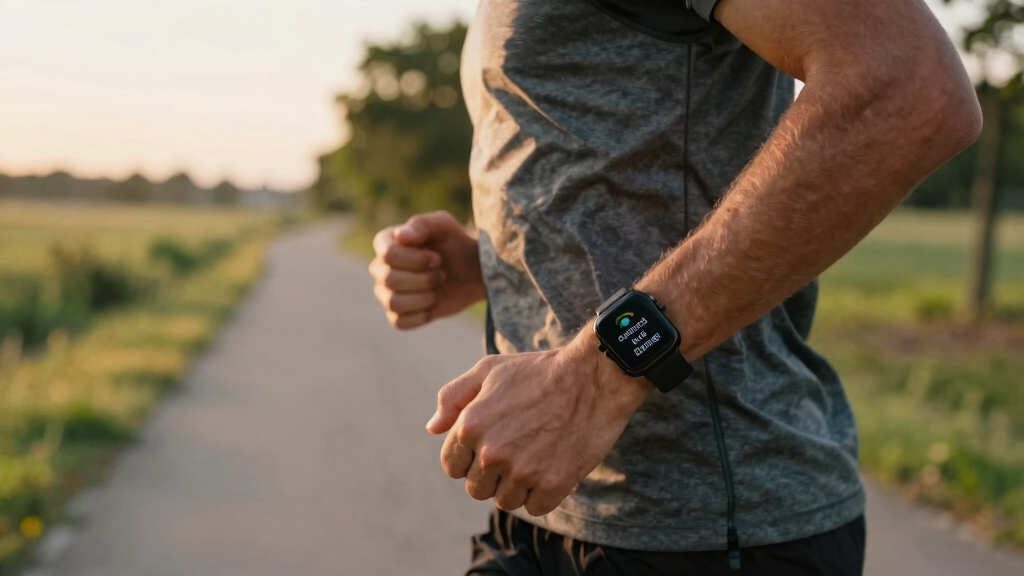
fitness tracker with heart rate sensor
As an affiliate, we earn on qualifying purchases.
As an affiliate, we earn on qualifying purchases.
Why Your Tracker’s Numbers Can Be Off — The Limitations You Need to Know
Fitness trackers aren’t perfect. They can underestimate or overestimate your calories, sometimes by as much as 20-30%. This variability matters because it influences how you interpret your progress. For example, if your tracker consistently underestimates calories burned during strength training, you might think you’re not making progress when you actually are. Conversely, overestimation can lead to frustration or overeating. The reasons for inaccuracies include sensor limitations—like difficulty detecting effort during activities that don’t involve much wrist movement—and biological variability, such as differences in metabolic rate. These inaccuracies highlight a crucial point: your tracker provides trend data, not an exact measurement. Recognizing this helps you avoid the trap of obsessing over precise numbers and instead focus on overall patterns, which are more meaningful for long-term health and weight management. Misinterpreting these can lead to misguided decisions—either overestimating your progress and becoming complacent or underestimating your effort and feeling discouraged. Therefore, understanding these limitations is essential for setting realistic expectations and making informed adjustments to your fitness routine.
As an affiliate, we earn on qualifying purchases.
The Role of Heart Rate Monitoring in More Accurate Estimates
Devices with heart rate sensors tend to give better calorie estimates, especially during steady activity. Heart rate data shows how hard your body is working, giving a clearer picture than just movement alone. For instance, during a run or cycling, a tracker with heart rate monitoring may better reflect your actual effort. But remember, even these aren’t foolproof—factors like stress, ambient temperature, or hydration can influence heart rate and skew results. This means that while heart rate data can improve the accuracy of calorie estimates, it’s still subject to biological and environmental influences. If you’re aiming for more precise tracking, combining heart rate data with activity type and duration can help, but it’s important to understand that it’s still an estimate. The tradeoff is that incorporating heart rate monitoring adds complexity and cost but provides a more nuanced view of your effort. This nuanced approach can help you better understand your true calorie expenditure, especially during sustained activities, but always interpret the data within the context of its inherent variability.
activity tracker for trend analysis
As an affiliate, we earn on qualifying purchases.
As an affiliate, we earn on qualifying purchases.
What’s New? How Tech Is Improving Calorie Estimates
Recent advances in wearable tech are making estimates more reliable. Some trackers incorporate additional sensors—like skin temperature or oxygen saturation—to refine calculations. Machine learning models analyze patterns over time for personalized estimates. For example, a smartwatch might learn your typical heart rate response to brisk walking versus running. These improvements are promising because they allow devices to adapt to individual differences, reducing some of the guesswork involved in calorie estimation. However, despite these innovations, the complexity of human physiology and environmental factors still prevent these devices from achieving lab-grade precision. They are, at best, increasingly sophisticated estimates that can help you notice trends and make better-informed decisions. The key implication is that technology continues to evolve, but users should remain mindful of the inherent limitations. Recognizing that these are still estimates—albeit smarter ones—encourages a balanced approach to using wearable tech as part of a broader health strategy.
accurate fitness tracker for calories
As an affiliate, we earn on qualifying purchases.
As an affiliate, we earn on qualifying purchases.
How to Interpret Your Tracker’s Data Without Getting Discouraged
- Focus on the trend, not daily fluctuations. Are your calories burned gradually increasing? That’s a sign of progress, even if individual daily numbers vary due to measurement inaccuracies.
- Use the data to boost your activity — not obsess over the exact numbers. Recognize that small inconsistencies are normal, and the overall pattern matters more than day-to-day precision.
- Combine tracker info with other habits: diet, sleep, stress levels for a fuller picture. This holistic view helps you understand how different factors influence your progress.
- Be consistent with device placement and input data for better comparison over time. Small changes in how you wear or set up your device can significantly affect readings.
- Remember: these numbers are rough estimates, not gospel. They are tools to guide your choices, not definitive measures of your effort or success.
Comparison Table: How Different Devices Estimate Calories
| Feature | Basic Fitness Trackers | Advanced Wearables |
|---|---|---|
| Sensors Used | Accelerometer only | Accelerometer + Heart Rate + Additional Sensors |
| Estimated Error Margin | ±20-30% | |
| Best For | Trend tracking and motivation | |
| Limitations | Less accurate during weightlifting or cycling |
What You Must Remember About Calories Burned on Your Tracker
Your tracker’s calorie count is a helpful guide, not a precise measurement. It shows general activity trends and can motivate you, but isn’t a perfect number. Use it as a tool to support your goals, not the sole source of truth. Recognize that individual differences, activity types, and sensor limitations mean the numbers are always approximate. Embracing this perspective allows you to focus on consistent effort and overall progress rather than chasing exact figures. Combining tracker data with other healthy habits—like mindful eating, strength training, and adequate rest—creates a more sustainable and realistic approach to fitness. Remember, the real value lies in understanding your patterns over time and making adjustments that align with your goals, rather than fixating on every calorie estimate.
Frequently Asked Questions
Are calorie counts from my tracker accurate enough to base my diet on?
They are best used as rough guides rather than exact measures. Relying solely on them for dieting can be misleading; combine with mindful eating and consultation with professionals for best results.Why do different brands give me different calorie numbers for the same activity?
Different algorithms, sensor quality, and data interpretation methods cause variation. Use a consistent device and focus on trends rather than exact numbers from different sources.Can I improve my tracker’s calorie accuracy?
Yes. Make sure the device fits well, input accurate personal info, and wear it consistently. Devices with heart rate monitoring tend to be more reliable during steady-state activity.Is indirect calorimetry the only way to truly measure calories burned?
Yes, lab-based methods like indirect calorimetry are most accurate but impractical for everyday use. For daily tracking, your tracker’s estimates—used wisely—are good enough for motivation and trend spotting.Should I ignore calorie counts altogether?
Not necessarily. Think of them as helpful indicators, not absolute truths. Use them to understand your activity patterns, but avoid obsessing over every number.Conclusion
Your fitness tracker’s calorie count is a helpful nudge, not a precise ruler. Think of it as a rough map guiding your activity, not a GPS for exact calories. Focusing on consistency and overall health makes your efforts more sustainable—and that’s the real goal. Keep moving forward, with your eyes on the bigger picture, not just the numbers.Fall Picks
fall essentials
As an affiliate, we earn on qualifying purchases.