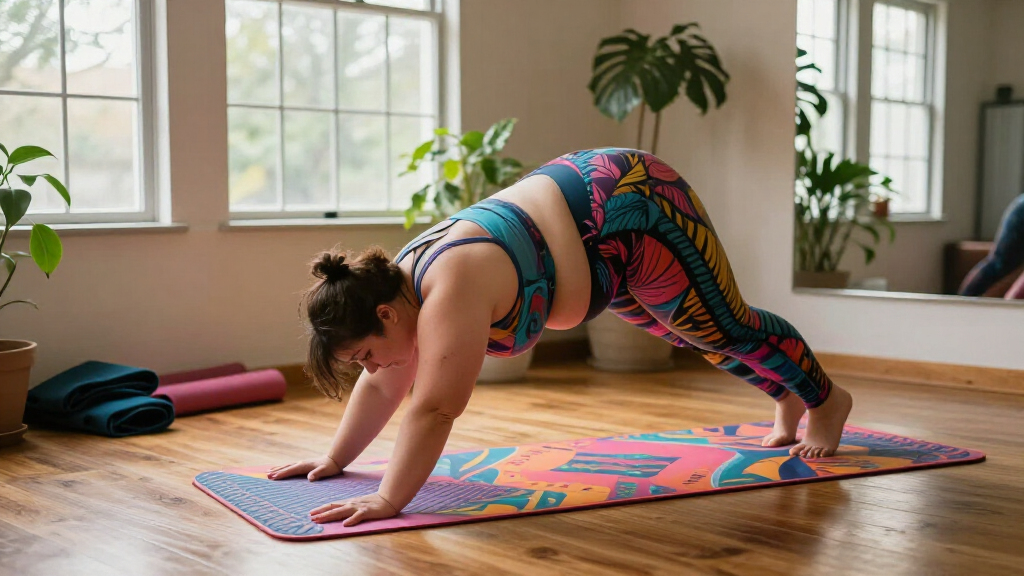
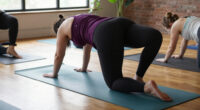
“Body-positive yoga mat” is not a single technical category: it usually describes a mat marketed around welcoming different bodies, often with a wider or longer practice surface, inclusive messaging, or both. The practical comparison is between an extra-wide, extra-long mat built to offer more room and a standard-size mat that suits many studios, storage spaces, and budgets.

Get workout gear delivered free with Prime
- Fast, free delivery on millions of items
- Prime Video, Amazon Music and more included
- Member-only deals all year

YR Large Exercise Mat, 78.7 x 51 Inches, 15 mm Thick
- ✔ Material: Nitrile Butadiene Rubber (NBR) foam
- ✔ Dimensions: 78.7 × 51 inches
- ✔ Thickness: 15 mm (0.59 inches)

Cork Yoga Mat with Natural Rubber Base, Non-Slip Grip, Extra-Long and Wide
- ✔ Top material: Natural cork
- ✔ Base material: Natural tree rubber
- ✔ Extra-long size: 80 × 26 inches
The central tradeoff is usable space versus convenience. A larger mat can make seated poses, wide stances, and transitions feel less constrained, especially for people whose hands, feet, or limbs regularly reach beyond standard dimensions. But it is heavier, takes up more floor and storage space, and may cost more. A standard mat remains a sensible choice if its dimensions already work for you. The right decision depends less on a label than on the measurements, grip, cushioning, and portability you need.
At a Glance
| Criteria | Extra-wide, extra-long body-positive yoga mat | Standard-size yoga mat | Winner |
|---|---|---|---|
| Practice space | Typically wider and/or longer; check exact measurements | Familiar dimensions; can feel restrictive for some bodies and poses | A |
| Grip and surface | Varies by material and finish; size alone does not improve grip | Varies by material and finish | Depends |
| Cushioning | May be thicker, but thickness varies by model | Available across a range of thicknesses | Depends |
| Portability and storage | Usually heavier and bulkier to roll or carry | Usually lighter and easier to store and transport | B |
| Studio compatibility | May extend beyond marked studio spots | More likely to fit standard studio spaces | B |
| Price and value | Often costs more; value depends on whether extra room is useful | Usually the less expensive choice | Depends |
| Inclusive design | May pair generous dimensions with inclusive branding; evaluate the actual features | May have inclusive branding or features, but is not necessarily designed around more space | A |
YR Large Exercise Mat, 78.7 x 51 Inches, 15 mm Thick
The YR earns our top spot because it makes room to move the defining feature rather than an afterthought. At 51 inches wide, it offers nearly twice the width of the cork mat, which can be especially useful when a practice includes wide-legged poses, floor-based mobility work, or transitions that take us beyond a narrow rectangle. Its 78.7-inch length is also substantial, and the product description notes that two people can exercise side by side. For a body-positive guide, that practical flexibility matters: we can choose positions based on comfort instead of constantly negotiating the mat’s edges.The other major distinction is 15 mm of NBR foam cushioning. Compared with the cork mat’s firmer rubber-backed construction, this is the more appealing option for people who find hard floors uncomfortable at the knees, hips, or back, or who mix yoga with Pilates and stretching. That padding can make floor work feel more approachable. The tradeoff is that a thick foam surface is not the same as a firm, traditional yoga mat; people who prioritize a close connection to the floor during balance poses may prefer the cork model’s denser foundation.Practical details make the YR easier to manage than its size suggests. It weighs 2.5 kg and comes with carrying straps and a mesh storage bag, while its moisture-resistant surface can be wiped clean. Still, the footprint takes more room to store than a standard mat, and a slight rubber smell may be present when new. We would choose it over the cork option for home workouts, cushioning, and space; we would choose the cork mat instead for moisture-responsive grip and a more yoga-focused surface.
Pros:
- 51-inch width provides substantially more side-to-side room than the cork mat.
- 15 mm NBR foam cushions joints during floor-based practice on hard surfaces.
- Works across yoga, Pilates, stretching, and general home workouts.
- Includes carrying straps and a mesh bag, with a manageable listed weight of 2.5 kg.
Cons:
- The oversized footprint can be awkward to store in a small home.
- A slight rubber smell may be noticeable when first unpacked.
- Thick foam may feel less stable than a firmer surface for some standing poses.
Best for: People who want a wide, cushioned mat for home yoga, Pilates, stretching, or mixed workouts, especially when practicing on hard floors.
Not ideal for: Travelers, people with very limited storage, or practitioners who prefer a firm, narrow surface for standing balance work.
Bottom line: We recommend the YR for buyers who value generous width and joint cushioning more than a compact footprint or firm, traditional yoga feel.
“We recommend the YR for buyers who value generous width and joint cushioning more than a compact footprint or firm, traditional yoga feel.”
Cork Yoga Mat with Natural Rubber Base, Non-Slip Grip, Extra-Long and Wide
Where the YR emphasizes generous width and softness, this cork mat is a more focused choice for grip during sweaty yoga. Its natural cork surface is described as improving traction with moisture, a useful distinction for hot yoga or practices where hands tend to slip as the session progresses. The dense natural rubber base adds a stable foundation, which gives this option a firmer character than the YR’s 15 mm foam. For buyers who want a surface designed around yoga rather than a general exercise mat, that difference is central.The extra-long size measures 80 × 26 inches, giving taller practitioners additional length compared with the YR’s 78.7 inches. But it is dramatically narrower: we get only about half the side-to-side space available on the YR. That makes the cork mat less appealing for expansive floor work or anyone who wants to move widely without repositioning. A 72 × 24-inch mini size is also listed, though the smaller format does not address the extra-long version’s core width tradeoff.Maintenance is straightforward: the cork surface can be wiped with water and air-dried, with prolonged direct sunlight best avoided. The main drawback is portability. At approximately 9.5–10 lb, the extra-long version is far heavier than the YR, and the product details give a weight range rather than one exact figure. A one-year manufacturer guarantee is noted, but the heavier build still makes it a better home or studio choice than a mat we carry frequently. Compared with the YR, this is the smarter pick for moisture-assisted traction and a stable yoga base; it is not the choice for maximum width, plush cushioning, or light travel.
Pros:
- Cork grip is described as improving with moisture, making it suited to hot yoga.
- Dense natural rubber base provides a stable, supportive foundation.
- 80-inch extra-long version offers more length than the YR mat.
- Cork surface wipes clean with water and can be air-dried.
Cons:
- The extra-long version weighs approximately 9.5–10 lb, limiting portability.
- At 26 inches wide, it offers much less side-to-side room than the YR.
- Its firmer construction does not provide the YR’s 15 mm foam cushioning.
Best for: Yoga practitioners who prioritize a stable, firmer surface and moisture-responsive grip, particularly for hot or sweaty sessions.
Not ideal for: Anyone seeking substantial joint cushioning, a very wide practice area, or an easy-to-carry mat for regular commuting.
Bottom line: We recommend the cork mat when grip and a grounded yoga surface matter more than width, plush cushioning, or easy transport.
“We recommend the cork mat when grip and a grounded yoga surface matter more than width, plush cushioning, or easy transport.”
As an Amazon Associate we earn from qualifying purchases.
Key Differences
The largest practical difference is the footprint. More width can give your hands and feet room in wide-legged poses, while added length can reduce the need to reposition between poses. That extra surface can ease the feeling of constantly correcting your placement. It does not make every pose easier, and it cannot replace a suitable floor, instruction, or supportive props, but it can remove one avoidable source of friction. Check the listed dimensions rather than relying on terms such as “oversized.”
More space also brings a cost in convenience. An oversized mat may weigh more, occupy more room at home, and extend beyond a studio’s usual mat spot. Standard mats are easier to carry and often less expensive, and they may be all the space a practitioner needs. Neither size promises better grip or cushioning: those depend on the specific material, surface texture, thickness, and construction. For value, pay extra only when the larger footprint solves a real problem in your practice.
Detailed Comparison
Practice space (Extra-wide, extra-long body-positive yoga mat wins — major)
A wins by a major margin if standard dimensions feel cramped. Extra width gives more room for wide stances and outstretched arms; extra length can help taller practitioners or people who move frequently between standing and lying poses. The benefit is personal: if your hands and feet stay comfortably on a standard mat, the larger surface may add little. Compare actual length and width with your current mat and the poses in which you run out of room.
Grip and surface (moderate difference)
There is no reliable size-based winner; this is a model-level decision. A roomy mat can still be slippery, and a standard mat can have an excellent grip. Look for clear material and surface details, and consider whether you practice hot or sweaty yoga. If possible, check care guidance and return terms, since grip can feel different across materials and may change with use. Do not pay a size premium expecting it to fix slipping.
Cushioning (moderate difference)
Neither category wins automatically. Some larger mats are thicker, but size and padding are separate specifications. More cushioning may feel gentler on knees and wrists, while a very soft or thick surface can make balance work feel less stable. Choose thickness for your joints, preferred poses, and floor conditions rather than assuming a body-positive mat is more supportive. If cushioning is the main need, compare thickness and firmness directly.
Portability and storage (Standard-size yoga mat wins — moderate)
B wins by a moderate margin. Standard mats are generally easier to roll, carry on public transport, fit into a small closet, and manage in a crowded class. An oversized mat can be worth carrying when its extra room improves comfort, but the added bulk is a daily tradeoff. If your practice involves walking to a studio or putting a mat away after every session, check packed dimensions and weight before choosing A.
Studio compatibility (Standard-size yoga mat wins — moderate)
B has a moderate practical advantage in shared spaces. Many classes use standard mat spacing, so an oversized mat may overlap neighboring areas or extend beyond a marked spot. That is not a reason to reject a larger mat if the studio allows it, but it is worth checking class layout or asking staff. At home, where you control the floor space, compatibility matters far less and A’s additional footprint may be a clear benefit.
Price and value (major difference)
The winner depends on whether you will use the extra space. A larger mat often costs more, but the premium earns its keep if a standard surface repeatedly interrupts your poses or makes practice less comfortable. If the dimensions are already sufficient, B is better value: spending more on unused area does not improve grip, cushioning, or teaching. Compare materials, warranty, and construction as well as purchase price; a low-cost mat that wears quickly may not be the better long-term buy.
Inclusive design (Extra-wide, extra-long body-positive yoga mat wins — minor)
A is more likely to address the need for room directly, but the gap is minor if branding is the only difference. “Body-positive” can signal welcoming messaging without changing the mat itself. Look for specific, useful features: dimensions that suit your body and practice, clear product information, and a company whose language avoids treating one body type as the default. A standard mat can still be inclusive if it fits the user and is marketed thoughtfully.
Extra-wide, extra-long body-positive yoga mat: Pros and Cons
Pros:
- More room for broad stances, reaching, and transitions
- Can reduce repositioning when a standard mat feels short or narrow
- May support a more comfortable home practice for people who need a larger footprint
Cons:
- Usually heavier and bulkier to carry and store
- May not fit standard studio spacing
- Can cost more without adding grip or cushioning
Standard-size yoga mat: Pros and Cons
Pros:
- Typically easier to carry, roll, and store
- Usually less expensive
- More likely to fit studio mat spaces and common storage setups
Cons:
- May feel restrictive for wide poses, longer limbs, or frequent movement
- Does not provide extra room for users who regularly reach the mat’s edges
- Standard sizing is not automatically the right fit for every body
Who Should Choose What
Choose Extra-wide, extra-long body-positive yoga mat if:
- Your hands or feet regularly land off the mat during poses.
- You are taller, have a broad stance, or want more room for seated and supine movement.
- You practice mostly at home and have enough floor and storage space.
- A larger surface would make you more comfortable returning to practice, and you accept the extra cost and bulk.
Choose Standard-size yoga mat if:
- Your current mat gives you enough room for the poses you do.
- You carry your mat to class, travel with it, or have limited storage.
- Your studio uses closely spaced standard mat spots.
- You would rather spend less or direct extra budget toward grip, cushioning, or durability.
Skip both if: Neither size fits your actual floor or studio space, or the available models fail your grip, cushioning, or material requirements. Look for a different size or construction rather than buying based on inclusive branding alone.
Value for Money
Paying more for A is worth it when the larger dimensions solve a recurring problem: limbs running off the edge, repeated repositioning, or a sense that standard space limits how comfortably you can practice. In that case, the mat’s value is the usable room, not the label. Before buying, compare its exact dimensions with your practice area and make sure it can be stored and carried in a way that works for you.
If a standard mat already fits, B is usually the better value. Put any extra budget toward a surface with the grip you need, appropriate cushioning, or construction that suits your care routine. A wider mat is not inherently more supportive or inclusive; it is valuable when its size matches a real need. Do not pay a premium for body-positive wording alone.
Final Verdict
Choose the extra-wide, extra-long body-positive mat if standard mats repeatedly feel too small and you mostly practice where a larger footprint will fit. For that user, the extra space is a meaningful improvement, not a cosmetic feature. Choose a standard mat if you are comfortable on one, often attend studio classes, or prioritize easy carrying, storage, and lower cost.
The deciding factor is whether you will use the extra area often enough to justify its price and bulk. For most people who already fit comfortably on a standard mat, B is the sensible buy. For anyone whose movement is routinely constrained by standard dimensions, A is the better fit—provided its size, grip, and thickness suit the actual practice space.
Frequently Asked Questions
What makes a yoga mat body-positive?
There is no universal technical definition. The term may refer to inclusive messaging, larger dimensions, or features intended to accommodate a wider range of bodies. Check the product measurements and specifications: the label alone does not tell you whether the mat will provide more room, grip, or cushioning.
How do I know whether I need an extra-wide mat?
Notice whether your hands or feet regularly reach beyond your current mat during poses, or whether you need to shift your position to stay on it. Measure the mat you use now and compare it with the listed width and length of alternatives. If you rarely run out of space, standard dimensions may be enough.
Is a larger mat better for joint comfort?
Not by itself. Extra area can give you more room to position your body, but cushioning depends on the mat’s thickness and firmness. If your knees or wrists need more padding, compare those specifications separately and consider whether a thicker surface will suit your balance practice.
Are oversized yoga mats suitable for studio classes?
They can be, but the footprint may overlap neighboring mats or exceed a marked practice space. Ask the studio about its layout before buying if you attend crowded classes. For home use, check that the mat fits your floor and storage area.
Should I pay more for a body-positive mat?
Pay more when the larger dimensions provide room you will use regularly and the mat also meets your needs for grip, cushioning, and durability. If a standard mat already fits, the premium is hard to justify on branding alone; a less expensive model may offer better value.
Fall Picks
fall essentials
As an affiliate, we earn on qualifying purchases.