Choosing an adjustable dumbbell set is less about finding one universally superior product and more about deciding which tradeoff will matter every time you train: a conventional-feeling handle and smaller increments, or a compact block-shaped design with a lighter starting weight and a path to heavier loads. The Bowflex SelectTech 552 and PowerBlock EXP Stage 1 are established options that serve those different priorities.

Get workout gear delivered free with Prime
- Fast, free delivery on millions of items
- Prime Video, Amazon Music and more included
- Member-only deals all year

BowFlex Results Series SelectTech Adjustable Dumbbells (Pair)
- ✔ Set: Pair
- ✔ Weight range: 5–52.5 lb per dumbbell
- ✔ Adjustment: Quick-adjustment dials
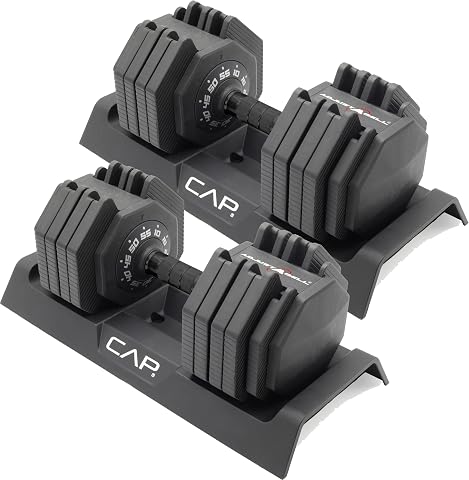
CAP ADJUSTABELL Adjustable Dumbbell Set, 10–55 lb
- ✔ Weight range: 10–55 lb
- ✔ Adjustment increments: 5 lb
- ✔ Adjustment mechanism: Full-rotation handle and cradle

UNNMIIY Adjustable 5-in-1 Dumbbell Set
- ✔ Set type: 5-in-1 multifunctional dumbbell set
- ✔ Exercise configurations: Dumbbells, barbell, kettlebells, push-up stands
- ✔ Adjustable weight per dumbbell: 2–22.5 lbs
The Bowflex 552 adjusts from 5 to 52.5 pounds per dumbbell, using a dial and relatively small early increments. The PowerBlock EXP Stage 1 covers 5 to 50 pounds per hand with a selector pin; optional expansion kits can raise its capacity. Bowflex is the easier recommendation for lifters who want a more familiar dumbbell shape and simple adjustment. PowerBlock is a stronger fit for buyers short on storage, people who want very light starting loads, or lifters who expect to add weight later. This comparison focuses on the practical differences: adjustment, range, handling, space, durability, workout flow, and value.
At a Glance
| Criteria | Bowflex SelectTech 552 | PowerBlock EXP Stage 1 | Winner |
|---|---|---|---|
| Weight range and increments | 5–52.5 lb per dumbbell; smaller increments at lighter settings | 5–50 lb per dumbbell at Stage 1; expansion kits raise the maximum | Depends |
| Adjustment system | Turn dials while the dumbbell sits in its tray | Select weight with a pin and lift from the block-shaped unit | A |
| Handling and exercise fit | More familiar dumbbell shape; bulky dimensions can affect some movements | Cage-style handle feels different from a standard dumbbell; compact body can limit certain grips | A |
| Storage footprint | Compact compared with a full rack, but each unit sits in a relatively wide tray | Very compact pair, with a stand available separately | B |
| Expansion potential | Fixed maximum of 52.5 lb per dumbbell | Expandable with compatible add-on kits, at additional cost | B |
| Durability and care | Selector mechanism and plates need careful handling; not for dropping | Robust design, but selector pins and plates still call for careful use | Tie |
| Value | Good value for a convenient 5–52.5 lb home set if its fixed range suits you | Strong long-term value for buyers who need a small footprint or plan to expand | Depends |
BowFlex Results Series SelectTech Adjustable Dumbbells (Pair)
For shoppers who want one pair to cover a wide range of conventional strength exercises, the BowFlex Results Series SelectTech is the easiest recommendation in this lineup. Its quick-turn dials select from 5 to 52.5 pounds per dumbbell, and the supplied storage trays give the weights a defined place to sit between workouts. That combination suits a home routine that moves from lighter accessory work to heavier presses or rows without needing a rack of separate dumbbells.Its main advantage over the CAP ADJUSTABELL is the stated range starting at 5 pounds, which makes it a more flexible fit for lighter movements as well as heavier work. CAP reaches 55 pounds, a small advantage at the upper end, but starts at 10 pounds and changes in 5-pound steps. BowFlex instead emphasizes quick dial selection; the supplied description does not specify its increment pattern, so buyers who need a particular small jump between weights should verify that detail before choosing.Compared with UNNMIIY, BowFlex is the more focused dumbbell tool: it does not offer a barbell or kettlebell conversion, but its metal plates, locking system, and non-slip handles are more directly aligned with repeated dumbbell sessions. The tradeoff is that 52.5 pounds per dumbbell may not be enough for lifters who are already strong or expect to progress beyond that ceiling. JRNY access is included for two months, but it should be treated as a temporary extra rather than a lasting reason to buy. We rank BowFlex first for its balance of stated range, quick selection, and dedicated-pair design—not because it is the heaviest or most versatile option.
Pros:
- Adjusts from 5 to 52.5 pounds per dumbbell for a wide range of exercises.
- Quick-turn dials make weight selection simpler than changing loose plates.
- Metal plates, a locking system, and non-slip handles support a dedicated dumbbell setup.
- Storage trays are included for keeping the pair organized.
Cons:
- The 52.5-pound maximum per dumbbell may limit stronger lifters’ progression.
- The supplied details do not specify the weight increments selected by the dials.
- JRNY access is only included for two months.
Best for: Home lifters who want a dedicated adjustable pair with quick dial changes and a broad stated range for mixed strength workouts.
Not ideal for: Lifters who need more than 52.5 pounds per dumbbell, want multiple equipment configurations, or require confirmed information about exact adjustment increments.
Bottom line: We rank BowFlex first for buyers who want a broad-range, quick-adjusting dumbbell pair, provided its 52.5-pound ceiling suits their training.
“We rank BowFlex first for buyers who want a broad-range, quick-adjusting dumbbell pair, provided its 52.5-pound ceiling suits their training.”
CAP ADJUSTABELL Adjustable Dumbbell Set, 10–55 lb
The CAP ADJUSTABELL suits buyers who want a conventional adjustable dumbbell without the extra configurations of UNNMIIY. A rotating handle selects between 10 and 55 pounds in 5-pound increments, giving lifters a clearly stated progression pattern. Its knurled steel grip offers a more textured handle feel than the ergonomic non-slip grip described for BowFlex, while the hex shape is designed to resist rolling when the dumbbell is set down.That 55-pound upper limit is the highest in this comparison, but the difference from BowFlex’s 52.5-pound maximum is modest. The more meaningful distinction may be the adjustment experience: BowFlex uses quick-turn dials, whereas CAP requires its included tray for weight changes. We would favor BowFlex for buyers who prioritize quick selection between sets; CAP makes more sense for someone comfortable returning the dumbbell to its cradle to choose the next load. Its 10-pound minimum also makes it less adaptable to very light exercises than BowFlex, which starts at 5 pounds.CAP’s nylon-coated plates and locking system are practical features for a compact home setup, and the storage tray keeps the adjustment components together. Still, the tray is not just an organizer: it is part of the weight-change process, so the dumbbell is less convenient if the workout space does not have room for that setup. Unlike UNNMIIY, this is not a multi-tool kit, and it does not claim barbell or kettlebell use. We see that narrower purpose as an advantage for buyers who want a dedicated dumbbell, but a limitation for anyone seeking one set to replace several kinds of equipment.
Pros:
- Rotating handle selects weights from 10 to 55 pounds in 5-pound increments.
- Knurled steel grip provides a textured handle surface.
- Hex shape is designed to reduce rolling when set down.
- Nylon-coated plates, a locking system, and a storage tray are included.
Cons:
- Weight changes require the included tray.
- The 10-pound minimum is less suitable for very light movements than BowFlex’s 5-pound starting point.
- The 55-pound maximum is only slightly higher than BowFlex’s 52.5-pound ceiling.
Best for: Lifters who want a compact, dedicated adjustable dumbbell with a knurled steel handle and clearly defined 5-pound weight steps.
Not ideal for: People who need weights below 10 pounds, expect to adjust away from the included cradle, or want a kit that converts into other equipment.
Bottom line: We recommend CAP for buyers who value a knurled steel grip and defined 5-pound steps more than dial-style changes or multi-exercise conversion.
“We recommend CAP for buyers who value a knurled steel grip and defined 5-pound steps more than dial-style changes or multi-exercise conversion.”
UNNMIIY Adjustable 5-in-1 Dumbbell Set
UNNMIIY’s 5-in-1 set is the choice for buyers who care more about getting several types of home-training equipment from one kit than about having the most conventional adjustable dumbbell experience. It can be configured as dumbbells, a barbell, kettlebells, and push-up stands, and the set is described as fitting in less than two square feet. That is a distinct advantage over BowFlex and CAP, which are centered on adjustable dumbbells rather than a collection of exercise configurations.The compromise is that changing the setup involves weight pieces and locking nuts, rather than selecting a load with BowFlex’s quick-turn dials or CAP’s rotating handle. Textured handles and foam padding on the connecting rod are intended to make gripping and using the bar connection more comfortable, while the locking nuts help secure the pieces. But this construction is not equivalent to the other two products’ metal-plate designs: UNNMIIY’s weights use cement and iron sand with a PE exterior. Buyers who prefer a more clearly specified metal dumbbell system may be better served by BowFlex or CAP.The stated per-dumbbell adjustment range is 2–22.5 pounds, so UNNMIIY is oriented toward lighter training and versatility rather than matching the upper loads offered by BowFlex or CAP. There is also an information gap: the product title references a set weight, but the supplied description does not clearly reconcile that figure with the per-dumbbell range. We would check the exact included total and configuration details before purchase. Compared with CAP, this set offers more workout formats but less clarity and a lower stated dumbbell ceiling; compared with BowFlex, it takes more setup effort in exchange for multi-use flexibility. It ranks third for a dedicated adjustable-dumbbell shortlist, yet may be the best fit when space and exercise variety take priority.
Pros:
- Converts into dumbbells, a barbell, kettlebells, and push-up stands.
- The stated setup stores in less than two square feet.
- Textured handles, foam padding on the connecting rod, and locking nuts address grip and security.
- Per-dumbbell adjustment is stated as 2–22.5 pounds.
Cons:
- Weight pieces use cement and iron sand with a PE exterior rather than the metal plates specified for BowFlex.
- The title’s listed set weight is not clearly reconciled with the per-dumbbell range.
- The maximum stated dumbbell weight is lower than both BowFlex and CAP.
Best for: Beginners or space-conscious home exercisers who want one kit for lighter dumbbell work plus barbell, kettlebell, and push-up-stand configurations.
Not ideal for: Lifters who need heavier dumbbells, prefer solid-metal plate construction, or want a clearly reconciled statement of the set’s total weight.
Bottom line: We choose UNNMIIY when compact storage and multiple exercise configurations matter more than heavier loads or a conventional quick-adjust dumbbell mechanism.
“We choose UNNMIIY when compact storage and multiple exercise configurations matter more than heavier loads or a conventional quick-adjust dumbbell mechanism.”
As an Amazon Associate we earn from qualifying purchases.
Key Differences
The main split is convenience in a familiar format versus compactness and future capacity. Bowflex’s dials are intuitive: set the dumbbell in its tray, turn to the desired load, and lift. The shape is closer to what many people expect from a dumbbell, and its lighter-weight settings offer useful small jumps. PowerBlock’s selector pin is also straightforward, but the unit’s enclosed, rectangular form and hand-in-cage grip are more distinctive. That difference can affect comfort and confidence, especially for exercises where the dumbbell rests against the body or rotates freely.
Range looks close on paper: the Bowflex tops out at 52.5 pounds, compared with 50 pounds for the base PowerBlock EXP set. But the PowerBlock’s add-on stages change the longer-term comparison. They cost extra, yet let owners increase capacity rather than replace the whole set when strength exceeds the starter range. Bowflex is simpler if 52.5 pounds will be enough. For storage, PowerBlock has the clear advantage; for a more conventional handle and lighter increments, Bowflex has the edge. Neither should be treated like a fixed dumbbell built to be dropped, so controlled use and care matter with both.
Detailed Comparison
Weight range and increments (moderate difference)
At their base configurations, the sets cover nearly the same top end: 52.5 pounds for Bowflex and 50 pounds for PowerBlock EXP Stage 1. Bowflex has an advantage for users who value its smaller early weight steps, which can make progression more manageable for beginners, isolation work, or rehabilitation-style training when appropriate. PowerBlock starts at 5 pounds as well, and its expansion options offer a higher ceiling if you buy the compatible kits. This is a moderate, user-dependent difference: Bowflex is more convenient within its range, while PowerBlock is better for a longer strength progression.
Adjustment speed and ease (Bowflex SelectTech 552 wins — minor)
Bowflex’s dial system is easy to understand and makes changing loads between exercises feel direct, provided each dumbbell is returned to its tray to adjust. PowerBlock uses a selector pin, which is also quick once the weight is chosen, but the block design and pin placement may feel less familiar at first. Neither has an advantage large enough to decide the purchase for most people. Bowflex wins narrowly for intuitive operation; PowerBlock remains fast and simple after a short learning period. The practical gap is minor.
Handling and exercise fit (Bowflex SelectTech 552 wins — moderate)
Bowflex looks and feels closer to a conventional dumbbell, which many buyers will prefer for curls, presses, rows, and general-purpose training. Its broad selector plates can still make the unit feel bulky compared with fixed dumbbells, and the size may interfere with a few movements or positions. PowerBlock’s enclosed handle gives a different sensation: the hand sits inside the frame, which can feel secure to some users but restrictive or unfamiliar to others. Bowflex wins for conventional handling, a moderate advantage for buyers who care about familiar grip and movement. If possible, try the PowerBlock grip before committing.
Storage footprint (PowerBlock EXP Stage 1 wins — major)
PowerBlock’s compact block shape makes it easier to fit into a small home gym, closet, or corner. Bowflex replaces a rack of separate dumbbells, but its two units and trays still take up more floor or shelf area. This is a major difference for apartment users and anyone sharing workout space. If storage is tight, PowerBlock is the more practical choice; if the set will live in a dedicated training area, the Bowflex footprint may be perfectly manageable.
Expansion and long-term range (PowerBlock EXP Stage 1 wins — moderate)
Bowflex has a fixed ceiling of 52.5 pounds per dumbbell, so lifters who outgrow it will need another set or a different solution. PowerBlock EXP can be upgraded with compatible expansion kits, giving it a route to greater loads while keeping the same basic system. That flexibility costs extra and requires checking that the kit matches the specific model generation. For users with a realistic plan to lift heavier, PowerBlock wins by a moderate margin. If the base range is plenty, the expansion feature has little value.
Durability and handling requirements (moderate difference)
Both systems rely on moving parts and selected plates, so neither is a substitute for rugged fixed dumbbells that can be dropped repeatedly. Bowflex’s trays and dial mechanism need careful alignment and controlled handling. PowerBlock’s pin and plate arrangement also calls for correct selection and careful use. There is no clear universal durability winner for ordinary home training; the meaningful difference is that both reward users who place the weights down rather than throw them. Treat durability as a tie, with careful use more important than the brand distinction.
Value for the money (moderate difference)
Bowflex can be the better immediate value if you want one ready-to-use set, prefer a standard-looking dumbbell, and do not expect to exceed its maximum. PowerBlock can deliver better long-term value for a space-conscious lifter who plans to buy expansion stages instead of replacing the set. Those upgrades add to the total cost, so the expandable design is not automatically cheaper. Compare the price of the base set plus any likely expansion with the cost of an alternative that already covers your target range. The winner depends on your space and future load needs.
Bowflex SelectTech 552: Pros and Cons
Pros:
- Familiar dumbbell-style shape and grip
- Dial adjustment is easy to understand
- Useful smaller increments at lighter settings
- Covers a broad range without separate weights
Cons:
- Larger storage footprint than PowerBlock
- Maximum weight is fixed at 52.5 pounds per dumbbell
- Bulky plates may interfere with some positions
- Requires careful handling and should not be dropped
PowerBlock EXP Stage 1: Pros and Cons
Pros:
- Compact design suits small training spaces
- Starts at 5 pounds per dumbbell
- Expansion kits provide a path to heavier loads
- Selector pin makes weight changes straightforward
Cons:
- Block-shaped handle feels less like a conventional dumbbell
- Some buyers may find the hand-in-frame grip restrictive
- Expansion stages increase the total purchase cost
- Compatibility should be checked before buying add-on kits
Who Should Choose What
Choose Bowflex SelectTech 552 if:
- You want a dumbbell that feels closer to a conventional design.
- You value smaller increments at lighter settings for gradual progression.
- You expect 52.5 pounds per hand to cover your home training.
- You prefer a simple dial system and have room for the trays.
Choose PowerBlock EXP Stage 1 if:
- Your workout area is small and storage space matters.
- You want the option to add weight later without replacing the core set.
- You are comfortable with the enclosed, block-style handle.
- You want a 5-pound starting point and a compact pair for mixed exercises.
Skip both if: Skip both if you regularly drop weights, need heavy loads beyond the PowerBlock’s upgrade range, or require the exact feel and balance of conventional fixed dumbbells. A sturdy rack of fixed weights or a different heavy-duty system may suit those needs better.
Value for Money
Paying more for PowerBlock expansion is worthwhile only if you are likely to use the extra capacity. If your training is expected to stay within the base 50-pound range, buying upgrade stages in advance adds cost without improving the workouts you can do now. The Bowflex 552 is often the more straightforward value for someone who wants a broad fixed range, conventional handling, and no need to plan around expansion.
PowerBlock offers stronger value when compact storage is a daily concern or when future strength gains would otherwise force you to replace the set. Count the base price and the expansion stage you expect to need, rather than judging by the starter kit alone. For a small room and a growing lifter, the extra spend can buy useful flexibility. For a buyer who does not need that flexibility, Bowflex is the more sensible purchase.
Final Verdict
For most buyers who want the familiar feel of a dumbbell and expect to stay below 52.5 pounds per hand, choose the Bowflex SelectTech 552. Its conventional shape, easy dial adjustment, and fine lighter steps make it a straightforward home set. Choose the PowerBlock EXP Stage 1 if storage is limited, if you like its enclosed grip, or if expansion to heavier loads is part of your plan. Its compactness and upgrade path are real advantages, not reasons to pay extra by default.
The biggest deciding factor is whether you value familiar handling now or compact storage and future range. Bowflex is the better fit for a typical home lifter who wants a ready-made set within a fixed ceiling. PowerBlock is the better long-term system for a space-conscious lifter who will make use of expansion. If you cannot tolerate either system’s handling limits or need weights built for repeated drops, choose neither.
Frequently Asked Questions
Which adjustable dumbbells are better for a small apartment?
PowerBlock EXP is usually the better fit because its block-shaped pair takes up less space than the Bowflex units and trays. The difference matters most when the dumbbells must be stored in a closet or shared room rather than left in a dedicated gym area.
Can PowerBlock EXP get heavier than Bowflex SelectTech 552?
Yes. The base EXP Stage 1 set reaches 50 pounds per dumbbell, but compatible expansion kits can raise its capacity. Bowflex 552 has a fixed 52.5-pound maximum. Check model and expansion-kit compatibility before purchasing an add-on.
Which set feels more like a regular dumbbell?
Bowflex 552 has the more familiar dumbbell-style shape. PowerBlock’s hand-in-frame grip is distinctive and can suit some users, but it does not feel like a standard handle. Buyers sensitive to grip shape should try the PowerBlock before deciding.
Are adjustable dumbbells suitable for heavy lifting?
They can support many home strength routines within their rated range, but these two sets are not designed to be dropped like robust fixed weights. If you need loads above their available capacities or routinely release weights forcefully, choose a heavier-duty system.
Halloween Picks
halloween
As an affiliate, we earn on qualifying purchases.