TL;DR

Get workout gear delivered free with Prime
- Fast, free delivery on millions of items
- Prime Video, Amazon Music and more included
- Member-only deals all year
An adjustable dumbbell set uses a pair of handles with removable plates or a built-in selector to change weight, saving the space that several fixed-weight pairs would need. Compare its usable weight range, adjustment increments, locking system, grip, footprint, and warranty—not just its maximum load—before buying.
A whole rack of dumbbells can take up more floor space than your workout area. An adjustable dumbbell set offers another route: one pair of handles, with weight you change as your workout changes.
This guide explains what they are, how selectorized and plate-loaded designs differ, and what to check before you buy. You’ll also see why the biggest number on the box may matter less than the small details you notice mid-workout, like a comfortable grip, manageable weight jumps, and a stand that makes each dumbbell easy to put away.
Say you have space for a mat, a chair, and little else. An adjustable set may fit your home better than a line of fixed weights—but only if its adjustment system and range work for the exercises you plan to do. Here’s how to make that call without getting distracted by hype.
Confirm whether the listed weight applies to each dumbbell or to the full pair, and check whether the set includes two dumbbells.
Compare selectorized and plate-loaded designs by adjustment speed, mechanism complexity, and how each fits your workout.
Check the full sequence of weight increments; the maximum load alone won’t tell you whether the set suits your exercises.
Measure the stand’s footprint and consider grip, balance, locking instructions, and return-to-cradle clearance.
Compare current warranty, replacement-part, and expansion details with the manufacturer or retailer before buying.
What an adjustable dumbbell set gives you in one small footprint
An adjustable dumbbell set uses one pair of handles with removable plates or a built-in selector to change the weight on each dumbbell. That lets you store several training loads in a compact area instead of lining up multiple fixed-weight pairs. The space saving comes from sharing handles and storage, but it also means you must pause to change the load rather than simply pick up another pair. It is a space-saving format, not a guarantee that every exercise or lifter will find it comfortable.
With a plate-loaded set, you add or remove plates and secure them with collars. Selectorized sets use a dial, pin, or lever—often on a stand—to choose from the available loads. Compact block-style models use their own selector or locking setup, and their shape and balance can feel different from a traditional dumbbell. These differences affect more than convenience: the adjustment process determines how readily you’ll switch loads, while the shape can influence wrist position, clearance, and how natural the dumbbell feels during a movement.
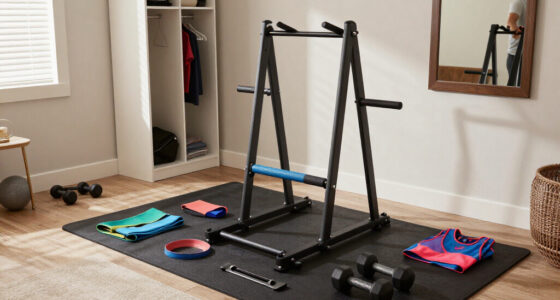
Imagine a small apartment corner with room for one stand beside a yoga mat. A single set could cover lighter raises, moderate rows, and heavier presses without storing a separate pair for every load. That convenience has a trade-off: switching weights can take longer than grabbing fixed dumbbells, particularly with a plate-loaded design. If you mostly complete all your sets at one weight before moving on, the delay may be minor. If you alternate exercises or share the set, frequent changes can interrupt your rhythm and make a quick workout feel less convenient.
Think of the set as several weights sharing one home. Before you buy, check how much space the full system needs, including its stand and the room your hands need to lift and return the dumbbells. A compact footprint on paper can still be awkward in use if you cannot approach the stand, set the dumbbells down securely, or move around it without hitting furniture.
The phrase “a pair of handles” can be misleading in a product listing. Some sets include two dumbbells; others are sold as a single dumbbell. Check whether the advertised weight applies to each dumbbell or to the pair, and confirm exactly what the box contains. This changes the practical value: a listed maximum might describe the capacity of one dumbbell, the combined load of two, or the package’s total weight, so comparing headlines alone can lead to buying less equipment than you expected.
adjustable dumbbell set with selectorized mechanism
As an affiliate, we earn on qualifying purchases.
As an affiliate, we earn on qualifying purchases.
Selectorized or plate-loaded: pick the adjustment style you’ll actually use
An adjustable dumbbell set usually falls into a few design families, and the practical difference is how you change the load. Selectorized models are generally faster to adjust, while plate-loaded versions involve handling plates and collars. Neither style wins for every home gym: convenience, simplicity, feel, and maintenance all matter. The best fit depends partly on how often your workout asks you to change weight. Saving a few seconds can matter if you switch repeatedly; it may matter little if you finish several sets before adjusting.
Picture changing from light shoulder raises to a heavier row during a workout. A selectorized dumbbell may let you turn a dial and lift it from its cradle; a plate-loaded one asks you to remove or add plates and secure the collars. That extra time may not bother you if you follow a steady plan, but it can interrupt a circuit where you change weights repeatedly. The selector’s speed comes with a more involved mechanism, while plate loading puts more of the process in your hands. Whichever you choose, a change is only convenient if you can complete it correctly and confirm the load is secure.
| Design | What changing weight involves | What to weigh up |
|---|---|---|
| Selectorized | Choose a setting with a dial, pin, or lever | Fast changes, but a more complex mechanism |
| Plate-loaded | Add or remove plates and secure collars | Straightforward design, but slower switches |
| Compact block-style | Use the model’s selector or locking system | Compact shape, but a different grip and balance |
During a store visit or delivery-day setup, test the motion with a light load if the instructions allow it. Can you change the weight without fumbling? Does the handle feel balanced in your hand? If the process is awkward before a workout, it may become more frustrating when you’re tired or trying to keep a routine moving. If two people share the set, a faster mechanism may save repeated adjustments—but make sure both can operate it correctly and return the dumbbells to the stand as directed.
Selectorized systems have more moving parts than basic plate-loaded designs, so look at warranty coverage and whether replacement parts are available. That complexity can be a worthwhile trade if fast changes help you use the set more often, but it gives you more model-specific details to check if a component wears or breaks. A simple design may appeal if you prefer fewer mechanisms; speed may matter more if your workout changes loads often. Pick for your routine, not a product category’s reputation.
compact adjustable dumbbell with stand
As an affiliate, we earn on qualifying purchases.
As an affiliate, we earn on qualifying purchases.
Choose a weight range that fits your exercises, not just the box
An adjustable dumbbell set should cover the lightest and heaviest loads you expect to use, with weight steps that make sense between them. Check the minimum and maximum weight per dumbbell, then read every increment across the range. A high maximum is not very useful if the set starts too heavy for your lighter exercises or jumps too far between settings. The range is only genuinely usable when you can select loads that suit both the movement and the person doing it.
For example, you might use a light load for lateral raises and a much heavier one for rows. If the next setting jumps by more than you can comfortably manage for a movement, you may have to stay at the lower load longer or choose another exercise. That is the trade-off behind increments: smaller jumps offer more opportunities to progress gradually and fine-tune a load, while larger jumps can make the available range simpler but leave gaps between useful settings. Larger steps may work well for some people and movements.
Before comparing products, write down a few exercises you expect to do and the loads you currently use, if you already train. If you’re new to lifting, don’t guess that one set will fit every future goal. Think about the exercises and the people who will use it, and ask a qualified fitness professional for help if you’re unsure how to select loads for your situation. This exercise-first check helps separate a useful range from a high maximum that looks impressive but may rarely be reached—or a minimum that makes lighter work impractical.
- Check the load per dumbbell, not only the combined number for a pair. This tells you whether each hand can reach the load your exercises require.
- Read the full increment pattern; settings may not rise by the same amount throughout the range. A gap that is manageable at heavier loads may feel too large for a smaller movement or a gradual increase.
- Match the lightest setting to the lighter movements you want to perform. If it begins above a comfortable working load, those exercises may not be served by the set.
- Consider sharing: two people with different strength levels may value more settings and quick changes. A broader range helps only if both users can find appropriate loads and the adjustment process is practical between turns.
Some listings state a total set weight, others advertise the maximum per dumbbell, and product descriptions can be easy to misread. Confirm the units and included plates before you compare prices. Shop for the range you can use, not the biggest number printed in bold.
As an affiliate, we earn on qualifying purchases.
Check the grip, balance, locks, and stand before you buy
An adjustable dumbbell set needs to feel secure in your hands and lock as its manufacturer directs. A comfortable handle, a shape that clears your body during movement, and a stable way to select or add weight can make practice smoother. These details affect whether the dumbbell feels predictable as you lift; an awkward grip or head shape can distract you, while an insecure or incorrectly engaged lock is a reason not to use the equipment. The plates or selected weights should be secure before each lift; never use a damaged set or assume it can handle being dropped.
Shape matters more than a photo suggests. Some compact designs look tidy on a shelf but feel bulky when you hold them close to your shoulders for a press. A block-style head may also sit differently against your thigh when you prepare for a seated movement. These differences can limit how you position the dumbbell even when its weight range is right. If you can try a model, grip it and move through a gentle range without weight first; notice whether the corners or handle interfere with your position.
Consider a real home setup: you finish a set of rows and need to return the dumbbells to their cradles. If the stand is cramped or the dumbbell must line up in one precise direction, putting it away may feel awkward when you’re tired. A stand that is easy to use can make each adjustment smoother, but its footprint and placement also determine whether the set fits your room. Check the footprint, clearance around the stand, and whether you can lift the dumbbell out and place it back without bumping nearby furniture.
Follow the manual for locking, cleaning, and storage. Do not drop an adjustable dumbbell unless the manufacturer explicitly says that model is designed for it; impact can damage plates, locks, or selector parts. Damage may not always be obvious, which is why following the model’s handling instructions matters more than judging it by appearance alone.
Maintenance depends on the model. One may need only routine cleaning and a visual check of its locks, while another has instructions about specific parts. Don’t add lubricant or make repairs based on guesswork; an incompatible change could affect how a selector or lock works. Follow the manufacturer’s guidance and stop using equipment that looks damaged. For pre-existing conditions or questions about safe exercise, consult a qualified professional.
dumbbell weight plates and collars
As an affiliate, we earn on qualifying purchases.
As an affiliate, we earn on qualifying purchases.
Use this five-step check to compare sets in a store or online
An adjustable dumbbell set is easier to compare when you work from your own needs instead of a list of marketing claims. Start with the exercises and available space, then check range, adjustment, handling, and support. Each step addresses a different possible mismatch: a set can have enough weight but take too much room, or fit the space but frustrate you every time you change settings. This five-step check also works when two product pages look almost identical.
- Measure your space. Include the stand and room to lift and return each dumbbell; a narrow corner may suit one layout but not another. Measuring the operating space—not just the stored footprint—helps you avoid a stand that technically fits but is awkward to use.
- Write down your likely loads. Include the light and heavier exercises you expect to do, and check weight per dumbbell. This makes it easier to spot a set whose headline maximum is high but whose minimum or available range misses your needs.
- Inspect the increments. Look at every step, not just the minimum and maximum; small jumps may help you progress gradually. The settings between the endpoints determine how many useful options you actually have.
- Test the adjustment and grip. If possible, check how the system locks, how quickly it changes, and whether the handle feels balanced. A system that is fast but difficult for you to operate correctly—or comfortable but slow for frequent changes—may not suit your routine.
- Compare the full cost and support. Review what’s included, warranty terms, replacement-part availability, and any expansion options. These details matter because a low purchase price may not tell you whether the set can be maintained or adapted as intended.
For instance, a buyer choosing between a fast selectorized model and a simpler plate-loaded set might value the selector during a short lunch-break workout. Someone who changes loads only a few times and prefers fewer moving parts may lean toward plates. The same feature can be a benefit or a nuisance depending on how you train. Consider the whole routine: the time saved by a quick adjustment may be valuable if it helps you keep moving, but less important if weight changes are infrequent.
Some sets offer extra plates or compatible attachments, while others stop at a fixed range. Treat expansion as a possibility to verify, not an assumption. Check whether accessories work with that exact model and whether the warranty covers the parts that matter to you. An expansion option is useful only if it adds loads you expect to use and remains compatible with the equipment you already own. Prices, availability, and warranty terms change, so confirm current details with the manufacturer or retailer before buying.
Know when adjustable dumbbells are worth the trade-off
An adjustable dumbbell set can be worthwhile if you want several loads in a small home workout area and you’ll use the equipment regularly. Its main advantage is storage efficiency: one set can take the place of multiple fixed pairs, but that comes with time spent changing settings and a shape that may not feel like a conventional dumbbell. It may not replace a full rack in every situation: fixed dumbbells can be quicker to grab, and some adjustable models aren’t designed for very heavy or high-impact use. Your best choice depends on the exercise range and how the equipment feels in practice.
Imagine two people sharing a spare room. One prefers light weights for controlled arm exercises; the other uses heavier loads for rows. One adjustable set could serve both if its range covers their needs and they can change settings without frustration. If they switch every minute, the adjustment time may become a nuisance; if they follow separate sessions, it may matter far less. Sharing makes the set more space-efficient, but it also means the range, increments, and adjustment process need to work for both users rather than just the stronger or more frequent user.
Compare the price per usable range, not just the sticker price or maximum load. A less expensive set may be poor value if its grip feels uncomfortable or its increments don’t fit your exercises. A pricier model may earn its place if faster changes and a suitable stand make workouts easier to stick with, but that convenience only matters if you actually use it. In other words, value comes from the loads and features that make your real workouts practical, not from capacity you may never need.
For many home routines, adjustable dumbbells can cover exercises such as presses, rows, curls, and raises, depending on their load range and shape. They don’t automatically match fixed weights for fast changes between users, very heavy lifting, or repeated dropping. Those are not small distinctions if they describe your training: check the manufacturer’s use instructions and be realistic about what you want the equipment to do.
The useful question isn’t “Can this set replace every dumbbell rack?” It’s “Can this set comfortably support the workouts I plan to do?” If the answer fits your space, budget, and training plans, a compact pair may be a sensible choice. If not, a different weight range or equipment style may suit you better.
Frequently Asked Questions
Are adjustable dumbbells suitable for beginners?
Yes, if the set includes a suitably light starting weight and you can adjust and handle it as directed. Check the weight steps as well as the maximum, since large jumps may not suit every exercise. If you’re unsure how to choose loads for your circumstances, ask a qualified fitness professional.
How quickly can you change the weight?
It depends on the design. Selectorized models generally change faster with a dial, pin, or lever, while plate-loaded sets require adding or removing plates and securing collars. Try the adjustment process if you can; a few extra seconds may be fine for one routine and frustrating in a circuit.
Are adjustable dumbbells safe to drop?
Only drop a model if its manufacturer explicitly says it is designed for that use. Impact can damage plates, selector mechanisms, or locks, even when a dumbbell looks fine at first. Follow the manual and stop using a set that is damaged or does not lock securely.
Do adjustable dumbbell sets always come as a pair?
No. Some sets include two dumbbells, while other listings sell a single one. Check what the package includes and whether the advertised weight describes each dumbbell or the total pair weight.
Can adjustable dumbbells replace a full rack?
They can cover many home strength exercises if their range and shape suit your routine, while taking less storage space than numerous fixed-weight pairs. Fixed dumbbells may be faster for frequent weight changes, and adjustable models may not suit very heavy lifting or repeated high-impact use. Compare your actual needs rather than expecting one format to suit every workout.
Conclusion
Choose an adjustable set by matching its weight range, increments, adjustment style, and footprint to workouts you genuinely plan to do. Then check how it feels to hold and how it locks; a big advertised maximum cannot make an awkward or unsuitable set a good fit.
Make room for the equipment you’ll use, not the rack you only admire. The right pair should feel at home beside your workout mat—and ready for your next set.
Halloween Picks
halloween
As an affiliate, we earn on qualifying purchases.