TL;DR
A 24-week trial involving 162 adults aged 65 and older with signs of mild cognitive impairment found that a progressive resistance-training group scored slightly higher than a gentle-exercise group on two cognitive tests. The groups performed similarly on story-recall tests, and the study does not show whether the differences affect daily life or dementia risk.
A 24-week randomized study of 162 adults aged 65 and older with signs of mild cognitive impairment found small advantages on two thinking tests among participants assigned to progressive resistance training, compared with those assigned to gentle exercise. The groups scored similarly on tests of story memory, and the results do not establish that strength training improves everyday independence or prevents dementia.

Get workout gear delivered free with Prime
- Fast, free delivery on millions of items
- Prime Video, Amazon Music and more included
- Member-only deals all year
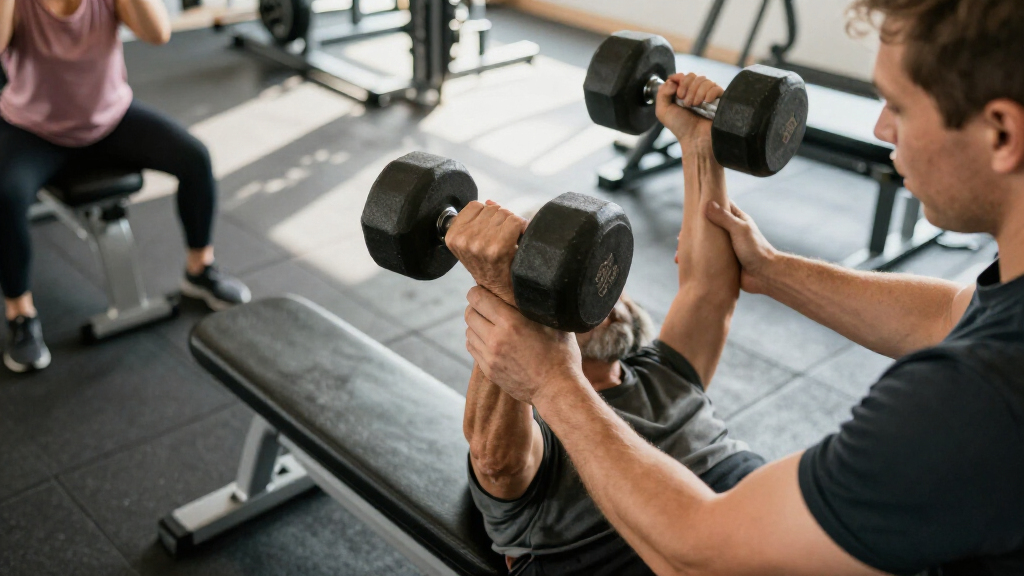
The study compared a program in which participants worked muscles against weights or their own body weight with a gentler exercise program. The strength exercises became progressively harder; during the program’s second half, some were performed on surfaces such as foam pads to make maintaining balance more challenging. The supplied study description does not give the exact exercises, session frequency, or the size of the score differences.
At the end of the program, participants in the resistance-training group scored slightly higher on a test requiring them to repeat a string of numbers immediately after hearing it and on a one-minute task naming words beginning with the letter A. On tests asking participants to recall details from a story immediately and after 30 minutes, the groups performed similarly.
The study was a randomized, assessor-blinded, sham-controlled trial, according to its title and the supplied citation. Its authors are listed as Dayane Tays da Silva and colleagues. The citation gives the journal as The Journal of Nutrition, Health and Aging, the year as 2027, and a DOI of 10.1016/j.jnha.2026.101030. The source material does not provide a direct statement from the researchers or detailed statistical results.
Strength Training and Brain Health What the trial found
A 24-week study found small advantages on two thinking tests for older adults assigned to progressive resistance training. It did not establish benefits for daily life, confidence, or dementia risk.
How the programs compared
Participants with signs of mild cognitive impairment were assigned to one of two exercise programs.
- Exercises against weights or body weight became harder over time.
- Some later exercises challenged balance on foam pads.
- Provided the comparison program.
- The study description gives no exact exercise schedule.
Thinking test results
The reported advantages were limited to specific tasks.
Repeat numbers
The resistance-training group scored slightly higher on repeating number strings immediately.
Name words
The group also scored slightly higher on a one-minute task naming words beginning with A.
Recall a story
The groups performed similarly on immediate and 30-minute story-recall tests.
What remains unknown
Test scores alone cannot answer whether training changed participants’ lives outside the testing session.
- Everyday independence, mobility, and confidence were not established.
- The account does not show whether differences were meaningful or lasted after training.
- The comparison cannot determine dementia risk or separate balance practice from strength work.
What the Test Differences Show
The findings offer a limited piece of evidence about resistance exercise and specific thinking skills in older adults with signs of mild cognitive impairment. Repeating numbers and generating words measure particular abilities; a small advantage on those tasks does not by itself show that people remember more in daily life, manage routine activities more independently, or feel more confident moving around.
That distinction matters to readers considering exercise as a way to support healthy aging. A training program may improve physical capacity and make some movements easier, but this trial, as described, does not establish a cognitive or dementia-prevention benefit. The results also cannot isolate the effect of balance practice: the intervention combined progressive strength work with more challenging balance conditions, and the comparison was a gentler exercise program.
The source frames strength training as one possible support for mobility and participation in everyday activities. If greater strength helps someone walk to a shop or attend a social activity, those practical outcomes may matter to quality of life. They were not, however, reported as demonstrated outcomes of this cognitive-test comparison. Confidence and independence remain important questions, not conclusions proved by the test scores.
Products Worth Considering

Oura Ring 4 Smart Ring, Silver, Size 8

Hyperice Normatec Elite Wireless Compression Boots

Oura Ring 5 Smart Ring, Silver, Size 7
As an affiliate, we earn on qualifying purchases.
How Strength and Balance Fit
Mild cognitive impairment refers to greater difficulty with memory or thinking than is typical for a person’s age, while the person can still manage most everyday tasks. Dementia is different: changes in memory or thinking interfere with daily life. The supplied material describes the trial participants as having signs of mild cognitive impairment; it does not say that they had dementia.
Strength gains can occur before muscles grow noticeably, in part because the brain and nerves become better at activating muscles for practiced movements. Repeating an exercise may also help with similar physical tasks: for example, squats use muscles involved in standing up from a chair. That is a plausible explanation for movement-specific gains, not evidence that practicing strength exercises directly improves memory.
The source outlines several possible routes by which exercise could relate to brain health, including changes in blood pressure, insulin response, inflammation, and signaling substances released by muscles. It also says research on these mechanisms is ongoing and findings about proteins linked to brain-cell activity have varied. These possibilities provide background, but the trial description does not show that any one mechanism caused its test results.
The source also cites a review covering studies of more than 2.6 million adults, which estimated that fewer than one in four did muscle-strengthening exercise at least twice a week. That figure is presented as an estimate from the review, not as a measure from the 162-person trial. Interviews with women who trained regularly reportedly found that some felt uncertain about their abilities or viewed strength training as something associated with men; those accounts are not findings from the cognitive trial.
Daily Benefits Still Unproven
The supplied account does not report whether the small differences on the number-repetition and word-generation tasks were statistically or practically meaningful. It also does not show whether participants moved more confidently, completed everyday tasks more easily, or maintained any gains after the 24-week program ended. Those outcomes cannot be inferred from the cognitive test results alone.
Whether the program changes the likelihood of developing dementia is unknown. The account also does not specify the participants’ health profiles beyond age and signs of mild cognitive impairment, how many completed the program, or whether adverse events occurred. Because both exercise groups received an intervention, the results as described compare two programs; they do not establish the effect of strength training against no exercise.
Finally, the researchers cannot tell from this comparison how much the balance challenge contributed separately from resistance training. The source notes that the program combined both elements. Further studies would need to test those components separately and measure outcomes that matter outside a testing session.
What Future Studies Need to Measure
The next useful step is research that tracks participants beyond the end of training and measures everyday function, mobility, confidence, and longer-term cognitive outcomes, alongside performance on laboratory-style tests. Studies that compare strength work with and without balance challenges could help identify which parts of a program are associated with any observed changes.
The supplied material does not identify a follow-up study, a planned next milestone, or a recommendation from the trial authors. For older adults considering resistance exercise, the reported results are not a personalized prescription. People who are new to strength training or have existing health conditions can seek guidance from a qualified health professional or exercise specialist about suitable movements and progression.
Key Questions
Did strength training improve every cognitive measure in the study?
No. The resistance-training group scored slightly higher on immediate number repetition and a one-minute word-generation task. The groups scored similarly on immediate and delayed recall of a story.
Does the study show that strength training prevents dementia?
No. The supplied account says whether the program affects dementia risk remains unknown. The study description reports results on cognitive tests, not proof of dementia prevention.
Was balance training tested separately from strength training?
No. Some resistance exercises were made more balance-challenging, but the program combined those elements. The researchers could not determine how much the balance challenge itself contributed.
Were participants shown to feel more confident or manage daily tasks more easily?
The source does not report those outcomes. It says further measures are needed to determine whether exercise affects confidence, everyday activities, or independence.
Source: medicalxpress.com