TL;DR

Get workout gear delivered free with Prime
- Fast, free delivery on millions of items
- Prime Video, Amazon Music and more included
- Member-only deals all year
Fit&Well has published a 10-minute home kettlebell routine featuring a half-kneeling halo, suitcase carry and dead bug variation. Certified kettlebell specialist Faith Ellis recommends light-to-medium weights, controlled technique and gradual progression; the supplied report includes no measured strength outcomes.
Fit&Well has published a 10-minute home kettlebell routine built around three exercises: a half-kneeling halo, a single-arm suitcase carry and a kettlebell dead bug. Certified kettlebell specialist Faith Ellis recommends the moves for training core stability, with light-to-medium starting weights and attention to form before increasing the load.
Fit&Well presents the routine as a short sequence for home use and recommends a kettlebell. The article says the exercises ask the trunk to stabilize during movement rather than relying only on repeated spinal flexion. Ellis says one-sided or offset movements also challenge the body to resist rotation and sideways bending. These are the report’s explanations for how the exercises may train the core.
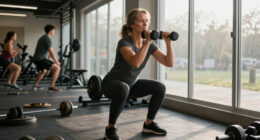
The first exercise is a half-kneeling kettlebell halo. The instructions call for three sets of four circles in each direction on each side. Starting with the kettlebell held at chest height, the exerciser circles it around the head while keeping the hips square, then changes the direction and switches kneeling sides. Fit&Well lists a starting weight of 10 to 18 pounds (4 to 8 kilograms).
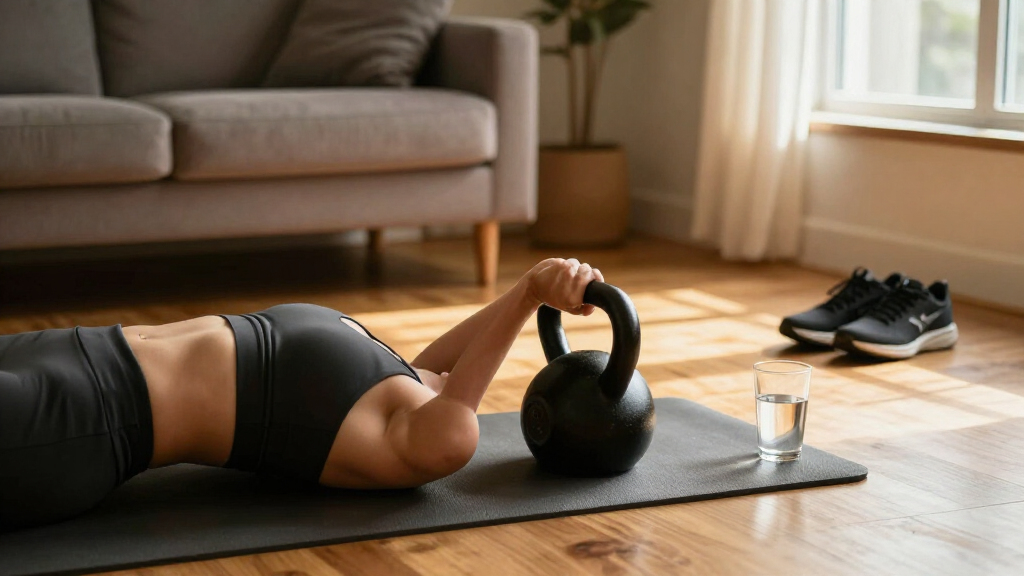
The second move is a single-arm suitcase carry: walk at a controlled pace for 30 seconds with the kettlebell held at one side, then change hands. The source recommends three sets and a starting weight of about 18 to 26 pounds (8 to 12 kilograms). The final move, a dead bug with a kettlebell pullover, is prescribed for three sets of six to eight repetitions per side. Lying on the back, the exerciser holds a light kettlebell above the chest, keeps the lower back pressed into the floor and alternates lowering one leg while bringing the kettlebell behind the head. Fit&Well suggests 10 to 18 pounds for this exercise.
A Short Routine for Home Training
The workout gives readers a structured option for fitting resistance exercise into a brief home session, using a kettlebell. Its three movements involve different positions and demands: moving a weight around the head, walking with an uneven load and coordinating arm and leg movement while lying down. That variety may make the routine useful for people seeking alternatives to exercises focused mainly on bending the trunk.
The suggested weights and rep ranges provide a starting framework. Fit&Well describes the workout as a way to build deep core strength at home in 10 minutes, while the supplied report does not include measured outcomes for the routine. Core strength gains depend on consistent, appropriate training.
Products Worth Considering

Bowflex SelectTech 840 Adjustable Kettlebell

Therabody Theragun Relief Massage Gun, 3-Speed, Navy

TheraGun Therabody PRO Plus 6-in-1 Deep Tissue Massage Gun, Black
As an affiliate, we earn on qualifying purchases.
Ellis’s Guidance on Progression
Ellis, identified by Fit&Well as a certified kettlebell specialist and founder of The KettleBelle, advises beginners to start with a light-to-medium kettlebell. She recommends prioritizing form, breathing and a neutral spine before adding weight. The report gives exercise sets and repetitions but does not provide a full timing breakdown for the session.
For progression, Ellis says to increase the load by 4 to 8 pounds (2 to 4 kilograms) once a set feels easy and can be completed with good form. She also suggests adding repetitions or slowing the movement. Fit&Well’s weight recommendations are guidance from the source, not individualized prescriptions; the right load can vary by exercise and person.
“Kettlebell exercises require the core to stabilize and transmit force rather than just flex the spine.”
— Faith Ellis, certified kettlebell specialist and founder of The KettleBelle, as quoted by Fit&Well
Results and Timing Are Unreported
The supplied Fit&Well report includes no publication date or formal study details and does not report measured strength outcomes for the routine. It attributes its recommendations to Ellis. Although Fit&Well describes the workout as taking 10 minutes, the supplied report does not provide a full timing breakdown. Individual results and the best starting weight remain variable; the report offers general exercise guidance rather than individualized recommendations.
The supplied report does not discuss readers’ individual health or injury histories. It also provides no information about physician review or participant testing.
Adjust the Load Before Progressing
Readers following the routine can begin with a manageable kettlebell and focus on controlled movement, breathing and a neutral spine. The source’s progression advice is to add weight in 4-to-8-pound increments, increase repetitions or slow the pace only after the current set feels easy with good form.
The supplied Fit&Well material presents the workout and Ellis’s guidance. Readers can use the listed weights and movements as general exercise guidance and adapt the weight and pace to their ability.
Key Questions
What exercises are in the kettlebell routine?
Fit&Well lists a half-kneeling halo, a single-arm suitcase carry and a kettlebell dead bug with a pullover variation.
What weight should a beginner use?
The source advises starting with a light-to-medium weight. It lists 10 to 18 pounds for the halo and dead bug, and about 18 to 26 pounds for the suitcase carry, but these are general recommendations, not individual prescriptions.
How should someone make the workout harder?
Ellis recommends progressing only when a set feels easy and can be performed with good form. Options include adding 4 to 8 pounds, doing more repetitions or slowing the repetitions.
Does the report prove the routine builds deep core strength in 10 minutes?
No. The report presents the exercises and expert guidance but does not provide a study, measured strength outcomes or evidence that results are guaranteed. Ten minutes describes the workout format, not a verified result.
Source: fitandwell.com