
TL;DR

Get workout gear delivered free with Prime
- Fast, free delivery on millions of items
- Prime Video, Amazon Music and more included
- Member-only deals all year
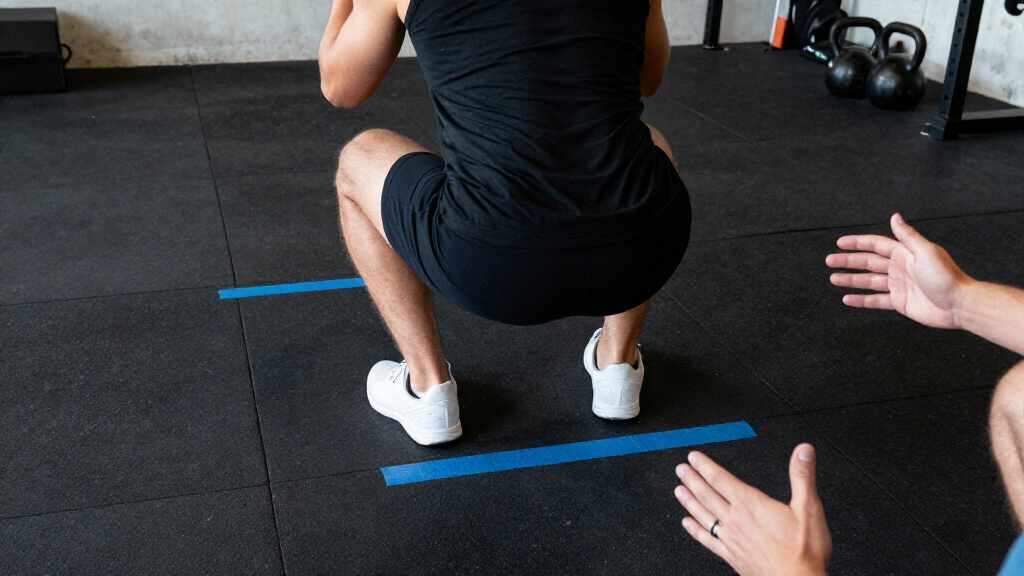
A Fit&Well report describes heel lift during squats as commonly linked to limited ankle dorsiflexion, while noting that hip mobility or strength may also contribute for some people. It recommends three scaled squat exercises—using suspension support, a chair and heel elevation—to build control and gradually work toward a heels-down squat.
A Fit&Well report outlines three modified squat exercises for people whose heels lift as they squat, saying the movement may relate to limited ankle dorsiflexion or, for some people, hip mobility and strength. The guidance matters because it cautions against assuming ankle and calf stretching alone will address every case, and suggests progressing through supported variations instead.
The report says limited ankle dorsiflexion is a common explanation: tight calves or ankle joints can restrict how far the shin moves toward the toes during a squat. It also offers another possible explanation for some people: lifting the heels may act as a protective response when the hips are particularly weak or tight. The report does not present this as a diagnosis for any individual.
Its first exercise is a suspension-trainer squat. Holding the straps provides support and reduces the balance challenge while the person practices lowering into a squat, keeping the knees open and pausing for a few seconds at the lowest point. The suggested progression is to rely less on the straps as strength and mobility improve.
The second option is a slow sit-to-stand from a sturdy chair, performed without pushing off with the hands and with a controlled descent. The third is a heel-elevated deep-squat hold, using plates or wedges under the heels to support a deeper position. The report advises reducing the heel height over time, with the aim of eventually holding the position with heels on the floor. It suggests practicing the movements regularly for a few weeks, then, once technique is comfortable, working toward three sets of each exercise for one minute, with one minute of rest.
Why Squat Modifications Matter
The report’s practical message is to treat a heel lift as a movement observation, not proof of one specific problem. If someone assumes the cause is always tight calves, they may focus only on ankle stretching; the report says hip mobility and strength may also matter for some people. Its regressions offer a way to practice the squat pattern with support or a reduced range challenge.
The exercises also provide different levels of assistance: straps help with balance, a chair makes the movement easier to control, and a heel wedge permits a deep squat without requiring flat-footed depth immediately. The proposed gradual progression is intended to build comfort and control, rather than force a particular depth. The source does not provide clinical evidence or a guarantee that these exercises will resolve heel lift for every person.
Products Worth Considering

Philips Sonicare 5950 Rechargeable Electric Toothbrush with 2 Brush Heads, Pink

Blueair Blue Pure 511i Max Smart Air Purifier

Therabody Theragun Relief Massage Gun, 3-Speed, Navy
As an affiliate, we earn on qualifying purchases.
How the Three Variations Progress
The report frames the exercises as squat regressions—simpler or supported versions of an unweighted squat. It advises starting by practicing each variation and exploring range gradually rather than focusing on a repetition target. The training prescription of three one-minute sets with one-minute rests is presented for when the person is confident with the technique, not as a requirement for the first attempt.
In the suspension squat, support can be reduced as the movement becomes easier. With sit-to-stands, the person can move from fully sitting down to lightly tapping the chair before standing again. For the deep-squat hold, the heel support can be lowered over time. These are suggested progressions in the report, not a fixed timetable; it does not specify how quickly any individual should advance.
“For some, however, especially those with particularly weak or tight hips, the heels lifting could actually be a protective mechanism to safeguard the body from injury.”
— Fit&Well report
What Heel Lift Cannot Confirm
The report does not establish why a particular person’s heels lift, and it gives no assessment criteria for distinguishing ankle restrictions from hip-related factors. It also does not cite clinical studies, quantify how often either explanation applies, or report measured results from people using the exercises. The suggested cause and exercises should therefore be read as general fitness guidance, not an individualized evaluation.
It is also unclear from the source how much practice is appropriate for people with pain, prior injuries or other health concerns. The report does not specify a universal timeline for reaching a heels-down squat or say that everyone needs to achieve the same squat depth.
Progress at a Comfortable Pace
The report recommends regular practice over a few weeks, with gradual changes to each exercise as control improves: less reliance on straps, a lighter chair touch, or a lower heel wedge. It gives no set date for progressing and does not promise that the exercises will correct heel lift in every case.
The report advises practicing each version, exploring range and improving gradually. It does not provide additional guidance about pain, injuries or consulting a professional.
Key Questions
Why might my heels lift when I squat?
The Fit&Well report says limited ankle dorsiflexion, sometimes associated with tight calves or ankle joints, is a common explanation. It also says hip tightness or weakness may contribute for some people. Heel lift alone does not confirm which factor applies.
Will calf and ankle stretches always fix it?
No. The report says stretching the calves and ankles alone may not address heel lift when hip mobility or strength is also involved. It recommends supported squat practice as another approach, but does not claim the exercises work for everyone.
What are the three exercises in the report?
They are suspension-trainer squats, slow sit-to-stands from a sturdy chair and a deep-squat hold with the heels supported on plates or wedges.
How often should I do the exercises?
The report suggests practicing regularly for a few weeks. Once technique feels confident, it proposes three sets of each move, working for one minute and resting for one minute. It does not set a universal schedule or progression speed.
Should I keep going if the movement hurts?
The source does not give a pain-management protocol. If the exercises cause pain, or if you have an injury or health concern, pause and ask a qualified health or fitness professional for individualized guidance.
Source: fitandwell.com