TL;DR

Get workout gear delivered free with Prime
- Fast, free delivery on millions of items
- Prime Video, Amazon Music and more included
- Member-only deals all year
Physiotherapist and Pilates instructor Helen O’Leary shared four standing exercises for people who struggle to exercise on the floor. The routine includes a standing book opener, scooter, march and hip abduction, with support options for balance.
Physiotherapist Helen O’Leary has recommended four standing Pilates exercises for people who find it difficult to exercise on the floor, according to a Fit&Well report. The sequence uses upright movements to work on mobility, balance and core stability, with a chair or other steady surface available for support, much like this low-impact Pilates workout for beginners.
The four exercises are the standing book opener, scooter, march and standing hip abduction. O’Leary, clinical director at Complete Pilates, says standing exercises can challenge the body differently from floor-based Pilates, while a three-move Pilates routine can focus on posture and stiffness. The report presents the moves as options to try at home, not as a prescribed treatment or a guarantee of particular results.
For the book opener, stand with feet hip-width apart and hands behind the head, then rotate the rib cage and head to each side. The report suggests three sets of four to five repetitions per side. O’Leary’s tip is to keep the pelvis facing forward to make the turn feel tighter.
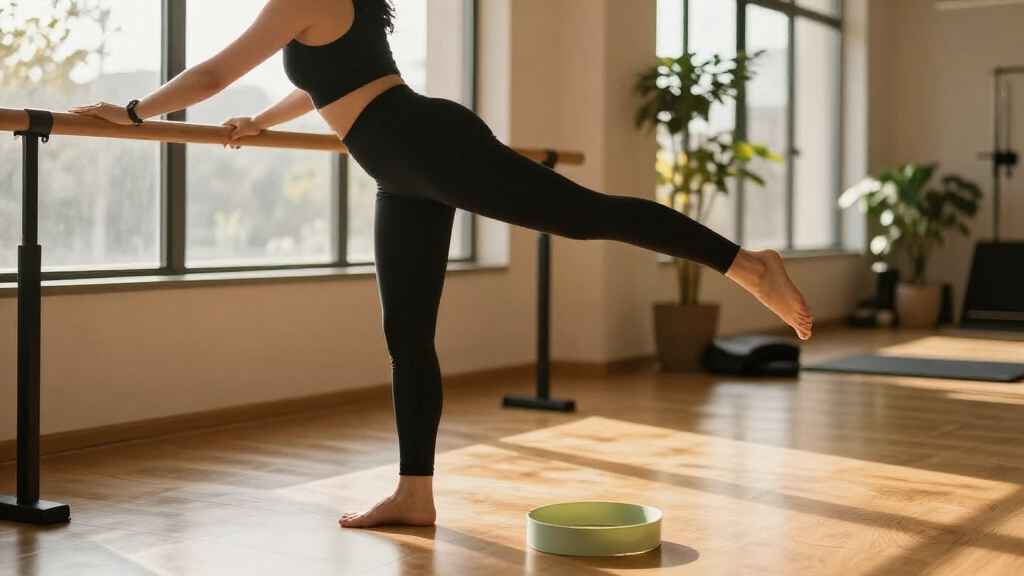
The scooter involves hinging at the hips while shifting weight onto one leg, then sliding the other foot back and forward with its toes on the floor. The report recommends three rounds of 10 to 15 repetitions per side. For the march, lift one knee while standing on the other leg, then switch; for hip abduction, lift a straight leg out to the side. It lists three rounds of 10 to 15 marches per side and up to 10 hip-abduction repetitions on each side. A table, chair back or countertop can provide balance support. A sock or towel under the moving foot may help with the scooter on a wooden floor.
Standing Options for Floor-Free Practice
The routine offers an alternative format for readers who have difficulty getting down to or up from the floor. The report also suggests using a stable surface for balance during the march and other exercises as needed.
O’Leary’s explanation is that upright Pilates can challenge core engagement and balance in ways that differ from mat exercises. She also says it may counteract effects of prolonged sitting by encouraging posture. Those are her stated reasons for the routine; the supplied report does not provide research findings, measurements or evidence that these four moves will produce a specific health outcome for every person.
The routine includes suggested repetitions and options for balance support. The article presents general exercise guidance rather than an individualized plan.
Products Worth Considering

Fitbit Sense Advanced Smartwatch – Sage Grey/Silver (One Size, S & L Bands Included)

Fitbit Versa 2 Health and Fitness Smartwatch with Bonus Bands

Blueair Blue Pure 511i Max Air Purifier for Home and Bedroom
As an affiliate, we earn on qualifying purchases.
How the Four Moves Work
Pilates is commonly associated with mat workouts and reformer equipment, but the Fit&Well report describes an upright approach that does not require either. The movements combine rotation, hip hinging, leg lifts and single-leg balance. The report says the moves can be tried at home.
The report’s instructions include some built-in adjustments. During the scooter, the toes stay on the floor as the foot moves, while the march and hip abduction can be done close to a surface. For hip abduction, O’Leary’s guidance acknowledges that the leg may not move far to the side at first and says the range may improve with practice. The supplied instructions do not include modifications for particular injuries or conditions.
“Standing Pilates exercises might sound as though they’re easy, but they test you in many ways that floor-based moves won’t.”
— Helen O’Leary, physiotherapist and clinical director at Complete Pilates, as quoted by Fit&Well
Limits of the Available Guidance
The supplied report does not give a publication date or provide evidence that the exercises improve posture, mobility or core strength for all participants. Those benefits are presented as O’Leary’s explanation of the exercises, not as measured results. The report does not address whether the sequence is suitable for people with specific injuries, balance disorders or other health concerns.
The instructions do not state how long to rest between sets or how to adjust the repetitions for different fitness levels. The report does not discuss whether the moves are appropriate for people with pre-existing conditions or provide advice for those who are unsure.
Trying the Routine Safely
The report does not announce a follow-up study, event or further program. It describes the movements as exercises to try at home, using a stable support where needed and following the stated repetitions as a guide. The scooter can be done with a sock or towel beneath the moving foot on a wooden floor.
The supplied material includes no additional developments or expert assessments about the routine.
Key Questions
Which standing Pilates moves does Helen O’Leary recommend?
She recommends a standing book opener, scooter, march and standing hip abduction, according to the Fit&Well report.
Do the exercises require Pilates equipment?
The report describes them as at-home moves that do not require a mat or reformer. A stable table, chair back or countertop can be used for balance support.
How many repetitions does the report suggest?
It suggests three sets of four to five book openers per side, three rounds of 10 to 15 scooter repetitions per side, three rounds of 10 to 15 marches per side, and up to 10 hip abductions per side.
Are these exercises suitable for everyone who struggles with floor workouts?
The report offers them as standing alternatives but does not establish that they are appropriate for every person. Anyone with an injury, balance concern or pre-existing health condition can ask a qualified professional for guidance before trying them.
Source: fitandwell.com