
TL;DR
Swimming engages nearly every major muscle group and offers low-impact cardiovascular benefits. It’s an efficient, versatile way to build total-body endurance that’s often undervalued in mainstream fitness routines.
Swimming engages nearly every major muscle group simultaneously, boosting overall muscular endurance.
Its low-impact nature makes it sustainable for long-term endurance training, especially for those with joint issues.
Water’s resistance amplifies effort, increasing cardiovascular capacity and muscular strength in each session.
Consistent swimming, including interval training, can significantly improve VO2 max and stamina.
Mixing strokes and gradually increasing intensity helps build balanced, sustainable endurance for all fitness levels.
Why Swimming Is Underrated for Total-Body Endurance
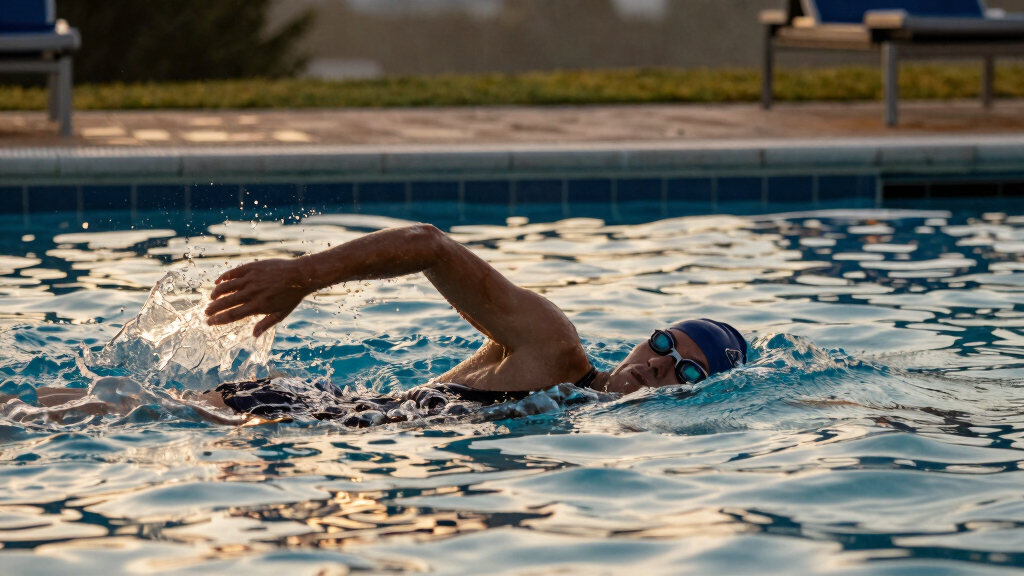
Swimming combines cardiovascular conditioning, muscular resistance and controlled breathing in one joint-friendly workout. Every stroke recruits the body as a connected system—turning the pool into a strength circuit, cardio session and endurance lab at once.
One stroke. Multiple systems.
Swimming asks the upper body to pull, the core to stabilize and the legs to propel—while the heart and lungs continuously supply oxygen. That simultaneous workload develops coordination and endurance more efficiently than isolated movement.
Shoulders + arms
Repeated pulling builds fatigue resistance through the shoulders, triceps, forearms and chest.
Back + core
Lats generate force while the trunk maintains alignment, rotation and an efficient body position.
Hips + legs
Flutter, breaststroke and dolphin kicks recruit the glutes, hips, quadriceps and calves.
Heart + lungs
Rhythmic breathing trains oxygen use, pacing and recovery under continuous movement.
Nervous system
Timing the pull, kick, rotation and breath strengthens whole-body movement efficiency.
Joints protected
Buoyancy supports body weight, reducing repetitive loading through knees, hips and ankles.

Hikeen Swimming Training Belt 4M Swimming Tether Swim in Place Harness Stationary Aquatic Resistance Belt
Designed for stationary swimming in home & lap pools with adjustable bungee cord for resistance training
As an affiliate, we earn on qualifying purchases.
As an affiliate, we earn on qualifying purchases.
Cardio meets continuous resistance.
Swimming’s defining advantage is its dual stimulus: the cardiovascular system works to deliver oxygen while nearly every movement meets resistance. Better technique lets you sustain that demand with less wasted energy.
Relative training stimulus
Conceptual profile based on muscle recruitment, impact and breathing demand.
Why the pool feels different
Resistance surrounds the body rather than arriving only when a foot strikes the ground.
load
best waterproof fitness tracker for swimmers
As an affiliate, we earn on qualifying purchases.
As an affiliate, we earn on qualifying purchases.
Swimming vs. land cardio
Running and cycling remain excellent endurance tools. Swimming stands apart when the goal is to combine broad muscle recruitment, cardiovascular work and low joint impact in the same session.
| Feature | Swimming | Running | Cycling |
|---|---|---|---|
| Muscle engagement | Full body, multi-muscle | Primarily lower body | Primarily lower body |
| Joint impact | ✓ Low | ~ Moderate to high | ✓ Low |
| Controlled breathing | ✓ Integral | ~ Self-paced | ~ Self-paced |
| Estimated calories/hour | 400–700 | 500–1,000 | 400–1,000 |
| Resistance pattern | Continuous, multi-directional | Gravity + impact | Pedal-driven |
| Cross-training value | ✓ Excellent | ~ Sport-specific | ✓ Strong |

Aquapella Swimming Kickboard – One Size Fits All – A Great Training Aid for Children and Adults (Navy)
User instructions with pictures included to help you practice your strokes and build swimming skills
As an affiliate, we earn on qualifying purchases.
As an affiliate, we earn on qualifying purchases.
A progression that lasts
Build the base
Swim steadily for 20–30 minutes at a manageable effort.
Add intervals
Alternate 30 seconds hard with 60 seconds relaxed.
Mix strokes
Vary muscle demand and reduce repetitive strain.
Track the work
Monitor distance, stroke rate, time and heart rate.
Progress slowly
Increase duration or intensity—not everything at once.
Starter interval set
Repeat the work-and-recovery block 8–10 times. Keep form smooth as fatigue rises.

PSIER Bone Conduction Headphones IPX8 Waterproof Swimming Headphones with MP3 Mode 32GB Memory, Open Ear Headphones with AI Music Generation 8 Hours Playtime Bluetooth 6.0 for Running and Fitness
Bluetooth + MP3 Modes: Underwater headphones with Bluetooth 6.0 ensure ultra-low transmission latency, significantly enhancing the music experience….
As an affiliate, we earn on qualifying purchases.
As an affiliate, we earn on qualifying purchases.
Train balance, not monotony
Freestyle is generally the most efficient choice for sustained endurance. Backstroke and breaststroke add useful variation, distribute fatigue and recruit the body through different movement patterns.
Freestyle
Best for sustained effort, efficient propulsion and rhythmic breathing over longer sessions.
Backstroke
Changes shoulder loading, opens breathing and provides a useful active-recovery option.
Breaststroke
Emphasizes hips, legs and timing while offering a controlled change of pace.
The endurance chain
Swimming’s value comes from a connected sequence: resistance creates muscular demand, controlled breathing challenges oxygen delivery and low impact makes consistent practice easier.
Before you dive in
Technique matters. Smooth alignment, efficient strokes and controlled breathing preserve energy and reduce injury risk as distance and intensity rise.
How often should I swim for endurance?
Begin with two or three sessions weekly. Progress toward four or five only after your technique and recovery remain consistent.
Is swimming suitable for joint problems?
Its low-impact nature often makes it accessible, but individual conditions differ. Seek clinical guidance when pain, injury or arthritis affects movement.
Can swimming improve other endurance sports?
Yes. It can preserve cardiovascular fitness, build upper-body endurance and add training volume without repeating land-based impact.
Can it replace every other form of cardio?
It can anchor a cardio program, but combining it with appropriate weight-bearing and strength work creates a more complete fitness plan.
How swimming hits almost every muscle — and why that matters
Swimming is a full-body workout. When you take a stroke, your arms, shoulders, back, core, and legs work together in perfect harmony. For example, freestyle engages your shoulders and back, while flutter kicks target your legs. This coordinated effort not only builds muscular endurance but also enhances neuromuscular coordination, which is crucial for overall athletic performance. The more muscles involved, the more energy your body consumes, leading to greater caloric burn and endurance gains over time.
Imagine trying to hold a plank while kicking your legs and pulling with your arms — that’s what swimming mimics, but with added resistance. It’s like doing a circuit of strength and cardio all at once. This comprehensive engagement means you develop strength and stamina simultaneously, making swimming a highly efficient workout. The tradeoff, however, is that mastering proper technique is essential to prevent injury and maximize benefits, especially as you increase intensity or distance.
Why swimming’s low impact makes it a game-changer for endurance
Ever felt your knees ache after a long run? Swimming sidesteps that problem because it minimizes joint stress through buoyancy. The water supports your body, distributing weight evenly and reducing the impact on your knees, hips, and ankles. This support allows you to train longer and more frequently without the risk of overuse injuries common in high-impact activities. Consequently, swimmers can sustain high training volumes that might be impossible on land, leading to superior endurance development.
For example, a runner recovering from an injury might switch to swimming to maintain cardio fitness without risking further damage. However, this low-impact advantage does come with a tradeoff: while swimming allows for high-volume training, it may require more time to see specific strength gains compared to weight-bearing exercises. Still, for endurance, the ability to train consistently without joint pain makes swimming an invaluable tool for long-term progress.
The science-backed benefits: what data shows about swimming and endurance
Recent scientific studies confirm swimming’s significant impact on endurance. Research indicates that consistent swimming can boost VO2 max — the maximum amount of oxygen your body can utilize during intense exercise — by up to 15%. This improvement translates into better stamina and quicker recovery during physical activity, which is vital for athletes and fitness enthusiasts alike. The enhanced oxygen delivery efficiency means your muscles work more effectively, delaying fatigue.
Additionally, water’s resistance adds a strength component to your cardio workout. With roughly 12 times the resistance of air, every stroke makes your muscles work harder, akin to lifting weights. This dual stimulus — cardiovascular and muscular — accelerates endurance gains but also requires careful progression. Overtraining or improper technique can lead to fatigue or injury, so understanding your limits and gradually increasing workload is essential for sustainable progress.
How to use swimming to boost your stamina — step-by-step
- Start with manageable sessions, like 20-30 minutes, focusing on steady, consistent effort. This foundation helps your body adapt without overwhelming your muscles or cardiovascular system.
- Incorporate interval training: swim at high intensity for 30 seconds, then recover with a slow, relaxed swim for 60 seconds. Repeating this pattern 8-10 times pushes your aerobic and anaerobic systems, leading to faster endurance improvements.
- Mix strokes: alternate between freestyle for sustained effort and breaststroke or backstroke to target different muscle groups and prevent monotony. This variation reduces the risk of overuse injuries and promotes balanced muscular development.
- Track your progress: use waterproof fitness trackers to monitor distance, strokes, and heart rate. Data-driven insights help you adjust training load and avoid plateaus.
- Gradually increase intensity and duration over weeks, listening to your body. Pushing too hard too soon can lead to burnout or injury, so incremental progress is key to long-term gains.
Swimming vs. land cardio: what’s really more effective?
| Feature | Swimming | Running/Cycling |
|---|---|---|
| Muscle engagement | Full-body, multi-muscle | Mostly lower body |
| Impact on joints | Low impact, joint-friendly | High impact, stress on knees and hips |
| Calorie burn/hr | 400-700 | 500-1000 (varies with pace) |
| Cardiovascular boost | High, improves VO2 max | High, especially with intervals |
Who should try swimming for endurance — and how often
Anyone looking for a joint-friendly way to build stamina can benefit. Whether you’re recovering from injury, dealing with arthritis, or just want a new challenge, swimming fits the bill. Its adaptability makes it suitable for beginners and advanced athletes alike, providing a scalable way to improve endurance without overloading the joints or risking burnout.
Start with 2-3 sessions a week, focusing on consistency. As your endurance improves, increase frequency to 4-5 times, mixing steady swims with interval training. Listening to your body is vital; gradual progression ensures sustainable improvements and reduces injury risk. The key is consistency and patience, allowing your body to adapt and grow stronger over time.
What strokes work best for endurance — and how to do them right
Freestyle is the most efficient for building endurance because it allows sustained effort with rhythmic breathing, making it easier to swim longer distances. Its efficiency reduces fatigue and enables longer sessions, which are essential for endurance. Breaststroke and backstroke are also effective, engaging different muscle groups and providing variety that can prevent boredom or overuse injuries.
For example, a triathlete might alternate between freestyle and backstroke to balance muscle fatigue and improve overall stamina. Focus on maintaining a steady pace and smooth breathing patterns. Proper technique—keeping your body aligned, using efficient arm strokes, and controlling your breathing—maximizes stamina gains and minimizes energy wastage, making your workouts more effective and sustainable.